UMD’s New $25 Million Main Production Kitchen Is a Game Changer
When it comes to the main things about world culture that have radically changed in the last half-century or so, surely the increased sophistication of the American palate has to be in the conversation.
Where once TV dinners, bland casseroles and fried everything was the norm, the past few decades of popular food television and writing and social media has led people to be much more adventurous. Now, multiculturalism is a crucial part of the typical diet. Whereas the older generations bristle at the simple mention of the consumption of, say, raw fish, the younger folks today gobble up sushi like candy.
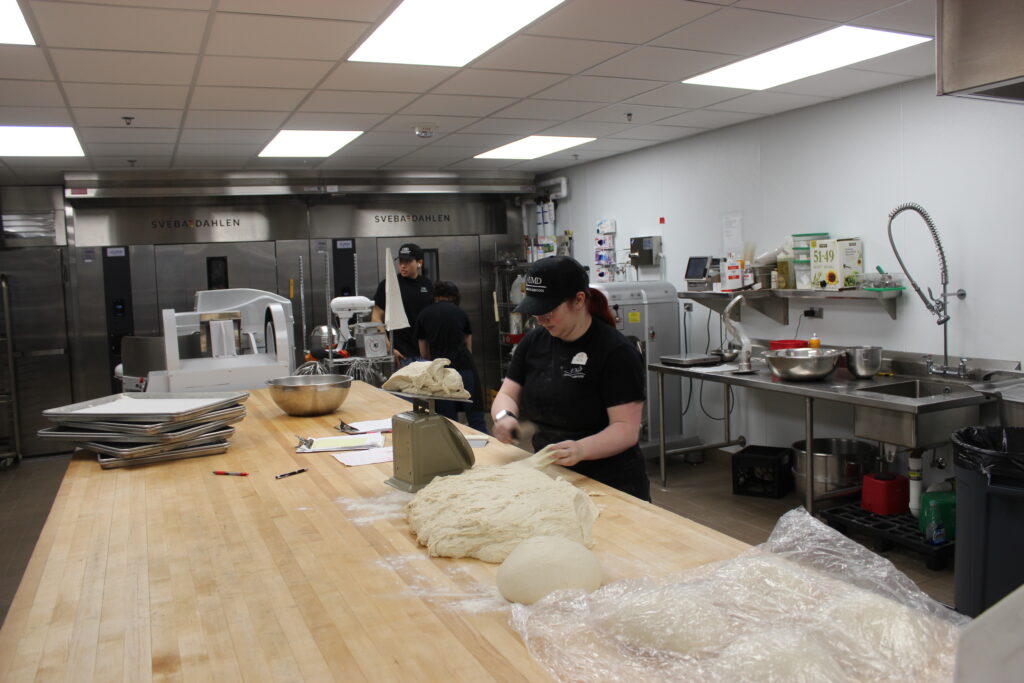
It’s in this climate that the University of Minnesota Duluth has unveiled its new Main Production Kitchen. Costing $25 million, self-funded by the school and meant to replace a space that was constructed and outfitted all the way back in 1971, the kitchen – long in the works – is an improvement and an upgrade on just about every level.
Tastes and times have changed, and UMD is meeting the demands of their students, faculty and guests in overhauling just about every aspect of their food-production department in response. Now, people from all over the world can find food that reminds them of home, and curious diners can have meals that scratch whatever itch they may have at any time of day.
The 1971 kitchen was meant to be able to serve 500 meals a day. Now, the new kitchen can serve thousands. Workflow is much better, and the equipment is much more able to handle modern needs in areas such as from-scratch baking.
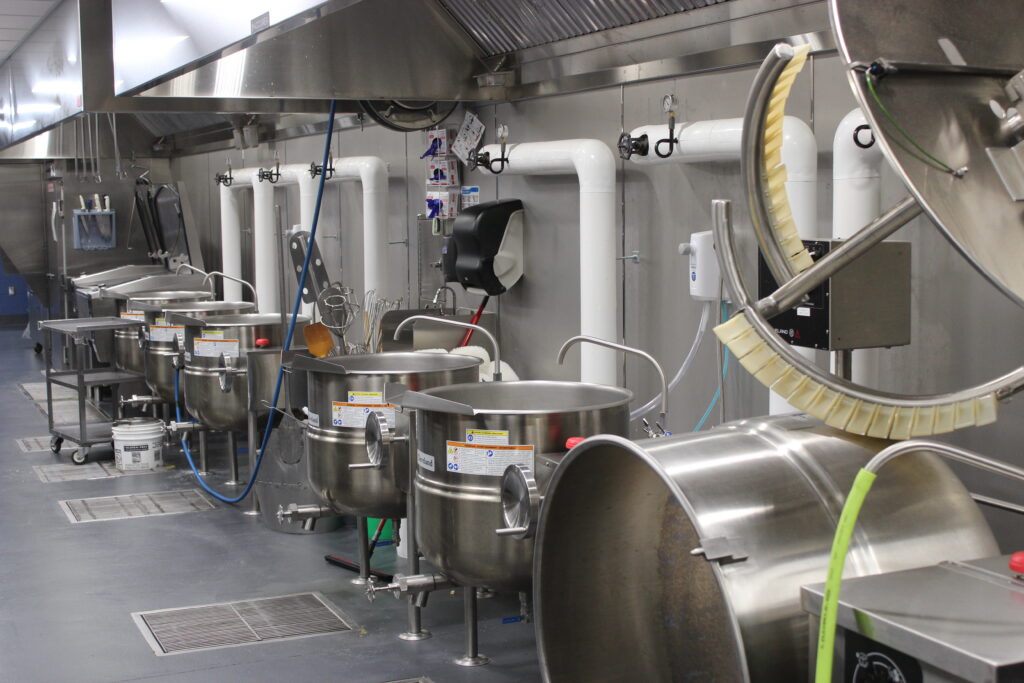
The new kitchen – built on the same footprint as before but much more flexible and responsive within that space – is even stimulating the creativity of the chefs who work in it on a daily basis in new ways. In every aspect, the new production kitchen at UMD is going to mean better experiences, better nutrition and teachers and learners who are better fueled to tackle whatever each new day brings.
UMD’s Dining Services Director Betsy Helgesen has been with the college for eight years. She said that, even though the most recent kitchen was built in 1971, that didn’t mean everything in it came from that same year.
“Some of the equipment that we were using came from the kitchen that existed prior to 1971,” she emphasized. “I like to joke that we certainly got our return on investment out of a lot of equipment.”
Indeed, that seems to be the case – UMD’s cooks were using 55-year-old gear at the very least, in some cases.
Of course, in 1971, the then-new kitchen was top-of-the-line, even with some grandfathered-in equipment.
“And it was also a different time, so it was a different model of cooking,” Helgesen said. “I mean, casseroles and constructed stuff. People served a lot of frozen foods. A different style of cooking entirely from what we see today.”
With time, Helgesen suggests, the downsides of the kitchen revealed themselves and only became more apparent as the world changed.
“We’re kind of space-poor,” she said. “We’re kind of constrained.”
As time went on and the school added housing and faculty and all kinds of other components, the kitchen produced food efficiently, but it couldn’t add dining facilities or new features. Revamping the kitchen itself now allows UMD Dining Services to carve out new paths of production.
“The Main Production Kitchen is sort of like a commissary kitchen, which means that 85 percent of the food produced and served somewhere on campus comes from that space, and then we kind of ship it out,” Helgesen said. “So, even though we have a food court where some foods are prepared, a lot of it also comes from the production kitchen and then comes up. Maybe they get vegetables that are already chopped. Or if they get soups, they’re made down in the production kitchen and come up there. If they have sub buns, the buns are baked in the main commissary kitchen.”
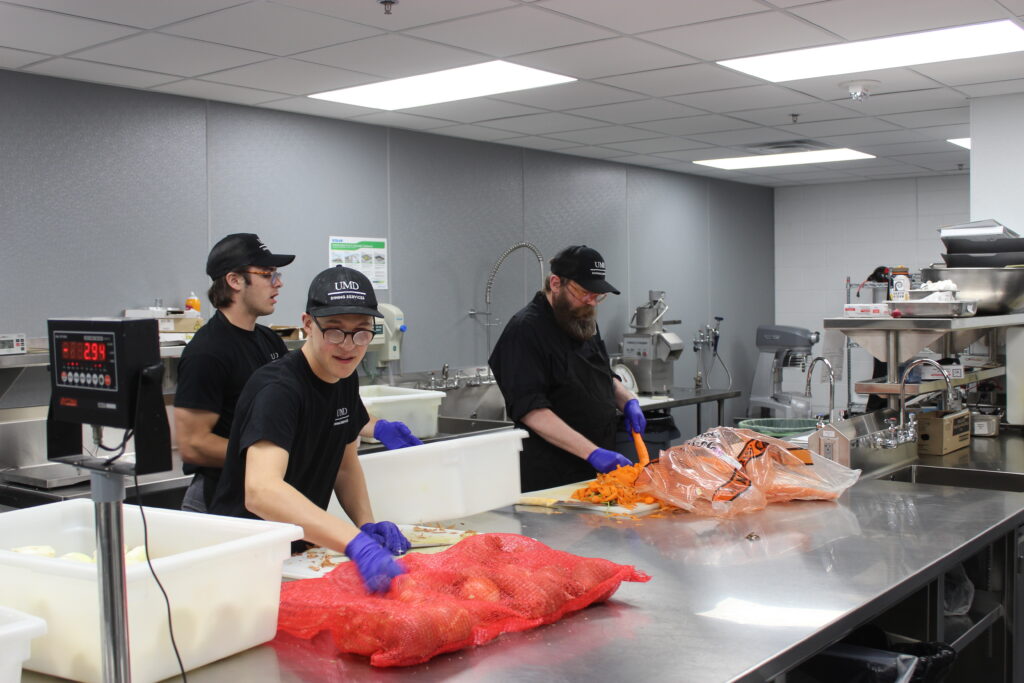
Revamping the origin point of most of the food made on the campus is a big deal, but it also now means that the foods themselves that the school prepares can change radically. The modern diner has different, individualized dietary wants and needs, and people on the UMD campus come from all across the globe, so they have varying tastes and preferences. The new production kitchen means UMD is now completely able to meet modern demands.
“Even when I came here, we were serving far more casseroles,” Helgesen said. “There’s meat and cheese and dairy and bread all in there, and that’s actually not good for a whole lot of different types of folks. I mean, there’s a lot of reasons you don’t want to eat gluten, and all of them are valid. And then, we’re all kind of getting to like fresher food. When I was in college, you kind of lived with whatever they had and there was really one choice for your entree. And now people expect to have choices and for the food to be higher-quality, and I think that’s a fair expectation.”
“Forty-two percent, I think, of our students come from the Twin Cities,” Helgesen said, “so they have exposure to a whole lot of different cultures and cuisines. You can’t just say, well, this is a local kid from Duluth and they don’t have a cosmopolitan palate. They’re coming from more metropolitan areas and other communities, states and countries.”
As food tastes and dietary requirements have changed, so have the staff at UMD. Now, they’re getting to use the latest tools in their daily duties.
“We’ve really increased the level of proficiency of the folks in the kitchen,” Helgesen noted. “We have chef and sous-chef-level cooks. Our executive chefs are quite magnificent. We get folks from – you can pretty much name any fabulous restaurant in Duluth. They want a different pacing and compensation and vacations and sick time and retirement. And they come to us and we get to harness all that talent. You can come here and explore your craft and make amazing meals. You don’t have to abandon the things you loved about cooking and only make tater-tot casserole every day.”
UMD Executive Chef Channie Mccall has been in her role since 2023, but she’s worked at the school since 2013. She said the new kitchen has changed her life.
“For us,” she explained, “it gave us an opportunity to start expanding our menu. This new kitchen has offered us the opportunity to fold more international dishes into our regular menu, whereas before, it was something we kind of did on special occasions. The equipment that we’re afforded the opportunity to use now has been incredible for executing some of those international dishes that require some more specialized cooking techniques. In the past, we had ovens and we had kettles, but now we have things in our operation like tilt skillets, which are really great for searing and braising right in one pot.”
“We’ve got some smart equipment around here,” Mccall continued. “Most of our [programmable] ovens can hold up to 8,000 recipes. They came preloaded with 2,000 recipes in each of them, but they’re built out so that we can actually program them for consistency across all of our menus. There’s a lot of really cool stuff happening with just the equipment alone, not to mention the space that we have to kind of spread out and, you know, make sure that our team isn’t tripping over one another.”
Mccall was involved like the other UMD cooks during the planning stages for the new kitchen, so she’s been able to get longtime wishlist items crossed off.
“My number one ask — I spent a lot of time helping design this kitchen and sourcing equipment and, y’know, layouts and what storage spaces look like – was a nifty mixing bowl that will mix up to 350 pounds of dough,” she said. “And then, once the dough is done mixing, we can actually use that mixer to lift the dough up and over the top of the machine and right onto our table. In the past, our staff would have to actually do a lot of really heavy lifting, which was not only dangerous in the moment, but also just really difficult on people’s bodies. Now, we have this incredible piece of equipment that saves our staff from potentially dangerous movements.”
UMD Assistant Director of Guest Experience Krista Padgett agreed the new kitchen is a game-changer.
“You can’t really talk about culinary without talking about guest experience, and you can’t really talk about guest experience in a dining operation without talking about the culinary aspects,” she explained, “and one thing that I’m really excited about for our students in this kitchen is that we get back to making things from scratch, which I know our team does an amazing job of and really takes pride in. And, within that, it helps our students have an experience that can be more like home for them. More home-cooked food and lovingly prepared great meals are really important.”
“One thing that we were able to start onboarding again is our multicultural series of dinners, where we partner with different multicultural groups on campus,” Padgett said. “We just did one with the South Asian student organization, where we get to partner with them to pick out recipes and figure out a way to make them on a huge scale – things that they maybe grew up with or remember their families making together and really enjoy and get to share those pieces of their culture with their classmates, which is so cool.”
That’s what’s key about the new UMD kitchen – it’s not just about people having fun new options or better workflow. Certainly, these are important upgrades. But the entire endeavor is really about improving the overall experience at UMD for students, staff and visitors. Good meals can affect mood, and being well-nourished and satisfied can mean one is better able to meet whatever challenges they’re meeting on campus for that particular day.
Eric Goodrich, Principal and Partner at foodservice designer and consultancy Rippe Associates, said their role in the project went back to before the pandemic, and plans morphed and changed over time.
“A lot of structural engineering feats had to happen for this space,” he explained. It’s underground and supporting everything above it. Part of the kitchen is actually over a crawlspace, part of it’s on grade, part of it has steam tunnels running through there. It’s a very complicated building to do any kind of renovation work on.”
Rippe’s work included an intensive early two-day charrette, visits to trade shows with the culinary team, and so on.
“We work from pre-design until after installation is taken care of,” Goodrich said. The millions of dollars of new machinery that was purchased was chosen carefully.
“‘Modernization’ is the key word. The equipment has to be much different than it was 50 years ago. They’re feeding two or three times the amount of students today that that kitchen was originally designed for. We were able to make it a much more efficient use of space and increase their storage and production capacity without increasing the footprint.”
TKDA Senior Registered Architect Corey Beste assisted in the design of the new kitchen. The confines of the space were a unique challenge, he suggested.
“There’s not a lot of elegant design in a space that’s underground with Kirby Drive going over the top of it,” Beste pointed out, adding that routing ductwork was a key challenge. “There were a lot of paths. Each of these systems had to kind of work around each other. For a renovation like this one to be successful, communication’s got to happen pretty consistently through the project.”
Contracting was done by McGough, whose Laura Witte managed production.
“[UMD] wanted a strong team to be able to execute that one,” she said. “Fortunately, we were chosen to do that.”
Once the project got underway in May 2024, her most notable challenge was first setting up temporary trailers to continue food production while the new kitchen was built. “That coordination was critical to minimize our impact on their operations,” she said.
McGough self-performed the general demolition, concrete, doors, frames and hardware, Witte said. Everything else was subcontracted out.
“Hiring local was big on the job,” she explained. “To be able to lean on the local trade partners was really important. A.W. Kuettel & Sons did the plumbing, HVAC and the roofing and metal panels on the job. They know the campus very well and have a lot of connections in Duluth. Probably a third of the scope of the entire project was them. And then Hunt Electric had the electrical and low voltage. We hired out a lot of other scopes, but mechanical and electrical drove a lot on this.
“Just as far as my own experience,”
Witte said, “this was a unique and challenging project. We came back out on the back end and learned a lot, in a positive way. We kept good morale, we had a good team and I was proud to be a part of that team.”
The brand-new Main Production Kitchen at the University of Minnesota-Duluth is the result of the hard work of many people over many years, but it amounts to a total overhaul of the way food is made at the school along every step of the way. It’s a change that was long needed, and the people that put in the time to make it happen are thrilled with the results.
And those who get to reap the benefits at mealtime are surely going to be very happy, too.
Tony Bennett is a Duluth-based freelance writer.