As you probably know as someone in the Duluth business scene, Duluth’s business landscape is uniquely positioned. It benefits from a strong sense of community, a steady influx of tourism and a consumer base that actively seeks to support local. Yet despite these advantages, many businesses are not realizing their full growth potential.
The issue is not a lack of effort. Across industries, business owners are investing in marketing, experimenting with new platforms and trying to remain visible in an increasingly competitive environment.
The challenge is more fundamental.
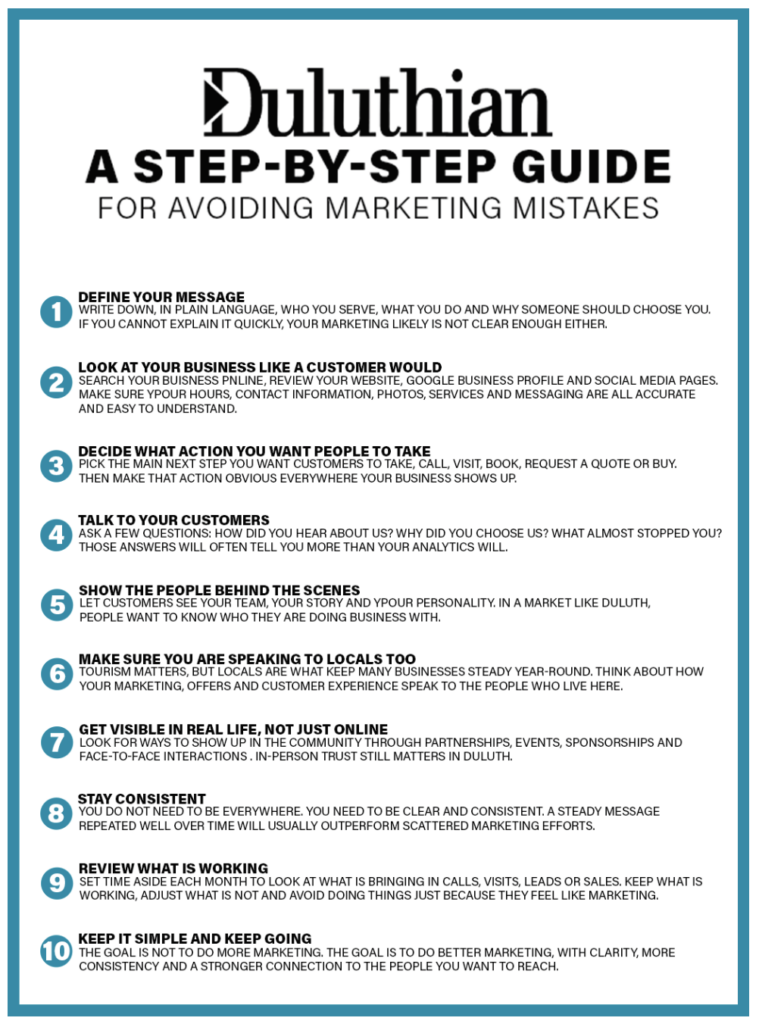
The most common marketing mistake Duluth businesses are making today is not inactivity, it is misalignment. Effort is being applied, but not always in a way that connects with customers, communicates clear value or drives measurable results. In today’s article we will be talking about the eight main areas where businesses miss out on marketing and how they can fix those mistakes with some critical thinking.
A Lack of Strategic Foundation
A recurring issue is the tendency to move directly into marketing execution without first establishing a clear strategy.
Tactics such as social media posting, digital advertising and website updates are widely used. However, without defined audience segments, positioning, and objectives, these efforts often lack cohesion.
Lisa Neitzel of Surge Communications in Duluth notes that many organizations “jump straight into execution of tactics without a clearly defined positioning, audience focus or measurable objective,” resulting in fragmented efforts that fail to produce meaningful outcomes.
This challenge is more common than many realize. According to CoSchedule’s State of Marketing Strategy Report, marketers who document their strategy are 300% more likely to report success than those who don’t
At its core, effective marketing begins with understanding three things, the product, the value and the customer. Businesses must be able to articulate who they serve, what problem they solve and why they are the preferred choice. Without this foundation, even well-executed campaigns struggle to perform.
Misalignment Between
Messaging and Customer Needs
Another consistent gap lies in how businesses communicate their value.
Many organizations continue to focus on internal messaging, highlighting their history, services or capabilities. Meanwhile, customers are making decisions based on relevance, ease and perceived benefit.
Rajiv Vaidyanathan, Professor of Marketing at the University of Minnesota Duluth, emphasizes that many businesses overlook fundamental marketing principles such as segmentation, targeting and positioning. Attempting to appeal to a broad audience often leads to diluted messaging and reduced effectiveness.
This gap is reflected in broader consumer behavior. According to McKinsey & Company, 71% of consumers expect personalized interactions, and 76% become frustrated when businesses fail to deliver them.
Customers are not evaluating businesses based on what they offer in isolation. They are evaluating how well those offerings align with their specific needs. The businesses that succeed are those that clearly and consistently communicate that alignment.
To avoid this, businesses should start by clearly defining their primary customer and the specific problem they are solving for that audience. From there, messaging should be simplified and focused on outcomes rather than features, making it immediately clear how the offering improves the customer’s situation. Regularly reviewing messaging through a customer’s perspective, and adjusting based on feedback, helps ensure that communication stays relevant, clear and effective over time.
A great tool is to create “customer avatars” who replicate 3-4 customer groups that you’d like to approach. These should include both their likes, dislikes and all things that make this group unique.
The Absence of Authentic Brand Identity
In Duluth, people know people. Your reputation gets around quick, good or bad. If what you’re putting out there doesn’t feel real, people pick up on it. Being authentic isn’t some marketing buzzword here, it’s kind of the baseline if you want to stick around.
Mariah McKechnie of Northland Special Events highlights that many businesses lack a clear sense of identity, or what she describes as “soul,” which can be immediately apparent to customers.
This importance is reflected in broader consumer behavior. According to Stackla, 88% of consumers say authenticity is a key factor when deciding what brands they like and support.
A well-defined brand goes beyond visual identity. It reflects purpose, values and personality. Businesses that are able to communicate their “why” and present themselves consistently across channels are more likely to build trust and foster repeat engagement.
Overreliance on Tourism at the Expense of Local Loyalty
For many businesses tourism remains a vital component of Duluth’s economy. However, an overemphasis on attracting visitors can come at the expense of building a reliable local customer base.
Shannon Laing of Rethos, who works closely with Minnesota Main Streets communities, notes that businesses that primarily cater to tourists often struggle to maintain consistency throughout the year.
Local customers provide stability. They drive repeat business, generate word-of-mouth referrals and sustain operations during slower periods. A balanced approach that prioritizes both visitors and residents is essential for long-term growth.
This is especially important when considering the value of repeat customers. According to Bain & Company, increasing customer retention rates by just 5% can increase profits by 25% to 95%.
Limited Use of
Customer Insight
Despite the availability of data and feedback channels, many businesses are not fully leveraging customer insight to inform their marketing decisions.
Angie Simonson of DBS Repair shared that integrating feedback from customer-facing teams into marketing strategy significantly improved performance, including reducing cost per lead and increasing engagement.
Similarly, Breanne Tepler of the Marshall H. & Nellie Alworth Memorial Fund observes that businesses often overlook their own stories and day-to-day work, failing to recognize what customers would find meaningful or engaging.
This is reinforced by broader research. According to McKinsey & Company, companies that prioritize customer experience significantly outperform those that don’t.
Organizations that actively seek input, both formally and informally, are better positioned to refine messaging, improve customer experience, and identify new opportunities.
Imbalance Between Digital and In-Person Engagement
While digital channels continue to grow in importance, in-person interaction remains a powerful driver of trust and conversion, particularly in a community-oriented market like Duluth.
Chris Navratil of Shamrock Productions emphasizes the lasting impact of face-to-face engagement through events and live experiences, noting that many customer relationships begin with a personal interaction.
At the same time, a strong digital presence is essential. Lawrence Trujillo of ThinkBIG Digital Marketing points out that many businesses are underusing foundational tools such as their Google Business Profile, which plays a critical role in local search visibility.
The most effective strategies do not rely exclusively on one channel. Instead, they integrate both digital and physical touchpoints to create a consistent and accessible customer journey.
Prioritizing Aesthetics
Over Outcomes
Another common challenge is the tendency to prioritize visual appeal over performance.
While strong branding and design are important, they must be supported by clear calls to action and measurable objectives.
Neitzel notes that marketing should guide the customer toward a specific next step, whether that is scheduling a service, making a purchase, or initiating contact.
If a potential customer cannot quickly determine what action to take, the opportunity is often lost.
A Clear Path Forward
Duluth’s business community benefits from a level of connection and authenticity that many larger markets lack. Businesses that align their strategy, messaging and execution with the expectations of today’s customers are well positioned to grow.
The path forward is not necessarily more marketing, but better marketing.
Clear positioning. Consistent messaging. Genuine connection. And a focus on delivering value at every stage of the customer experience.
In a market defined by community, those fundamentals remain as relevant as ever.