Founder Bob Gardner Had a New Vision for Project Supervision
This summer, the Duluth hub of Gardner Builders, the company that calls itself a “”commercial builder delivering with hospitality,” celebrated its first decade in operation.
Established in Minneapolis in 2010 by Bob Gardner, the company quickly expanded into Duluth and Milwaukee and today employs around 260 people across its three hubs. These folks are all people at different stages in their lives, but each one of them attests that working at Gardner has been a huge positive.
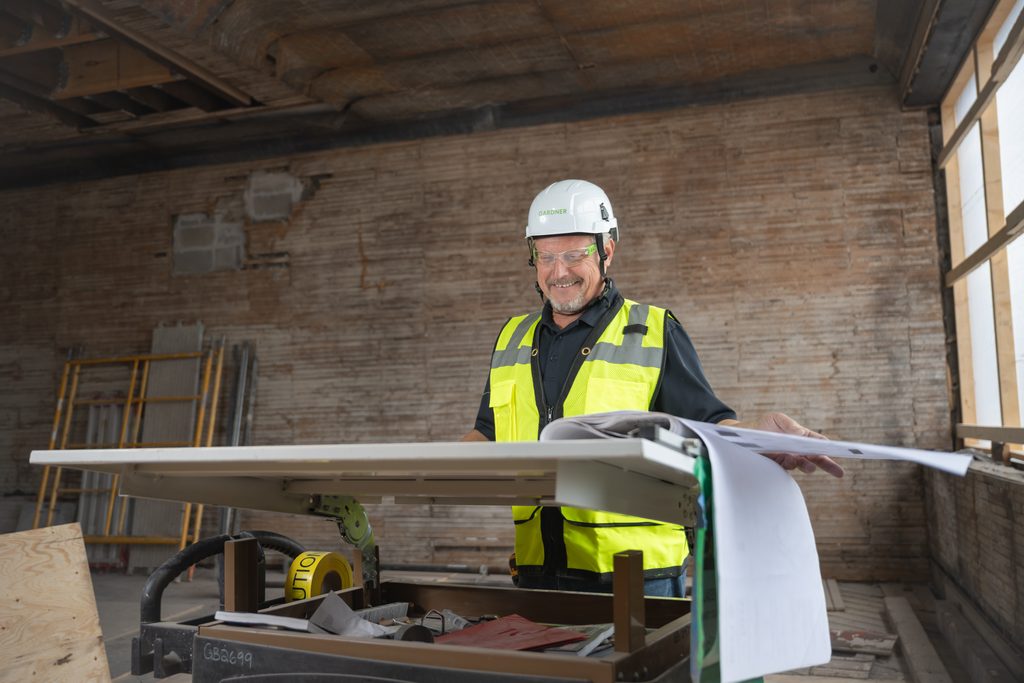
Rod Kalina
“I believe, all in all, there’s probably close to 26 or 27 superintendents,” said Rod Kalina, one of those very superintendents who works in the Duluth office. “Our job is basically to manage the job sites. When we have a client that comes to Gardner Builders and decides to use us to [do an] interior remodel of an existing space or a new space, or – like we just did in Sandstone – take a historic building that was built in 1901 and bring it back to life, our job as a superintendent is to manage all of our trade partners on site to make sure that it goes as smoothly as possible, and to also make sure that the vision that the clients and the architects have at the end is what they envisioned a project being when they drew it up.”
Kalina originally had met with Bob Gardner not long after his company was founded, but he said it ended up not being the “right time” for him to become an employee. After a relocation to the Northland, the right time finally came along.
“We had bought a place north of Two Harbors because we love the North Shore, we love Duluth, we love Grand Marais, and we plan on retiring up here, so when I realized that Gardner had an office in Duluth, I went back to Bob and I said, OK, I think it’s probably the right time for us to team up. It’ll be seven years in October, and it’s been the best seven years of my life. I haven’t had this much fun being a superintendent as I have since I’ve been up here with Gardner.”
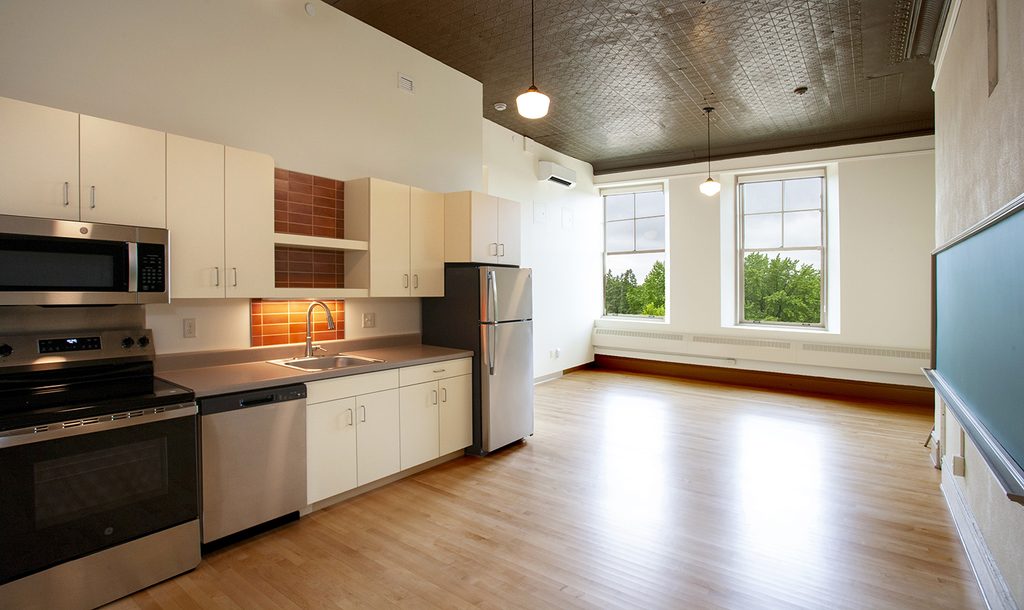
Gardner was hired to transform the former Sandstone Public School (known as “The Rock”) into The Bookmatch, a 32-unit workforce housing complex.
The aforementioned Sandstone project is an example Kalina gives. It was an opportunity to work in a place where metro-area contractors don’t often go and transform a disused public school into a fresh, new apartment complex called The Bookmatch.
“That’s where you really get to enjoy the small-town hospitality,” he said, “and that’s what I was able to experience for 11 months in Sandstone. That was probably the most fun project that I had ever done, and I’ve been doing this for over 40 years.”
“It’s just the way that Gardner presents itself to not just the client and the trade partners that we use, but to the places that we go,” Kalina said. “Every place that we go, what we try to do is make sure that we truly do show hospitality to that community, because for the most part, when we’re in those communities, they’re showing it to us. It’s our job to make sure that we are giving back as much as we can to those communities. When we were in Sandstone, every Thursday morning at 7:30, there’s donuts on the job site. I hooked up with Chris’ Food Center in Sandstone, and, over the course of those 11 months, I had 3,000 donuts brought into the job site. It was pretty awesome to see, every Thursday morning, all the trades coming to the table around 7:30, quarter to 8 to get the donuts. So, Gardner gives me the opportunity to be who I am and not be micromanaged. That’s what has made the last six or seven years up here really enjoyable, for me.”
This example is a common refrain among the employees of Gardner in Duluth. According to Kalina, it’s a tone that was set by the founder.
“When Bob Gardner started the company 16 years ago, he had a vision,” he explained. “He never wanted to make Gardner Builders look like we were sitting up on a throne and everybody else was below us. When the trade partners come to the job site, they’re as much of a valued asset to that project as we are. They know that they’re going to be treated with respect and we’re going to do everything that we can as a superintendent to make sure that we make it as efficient and for them to be able to make their profit margins and things like that, but also to have fun.”
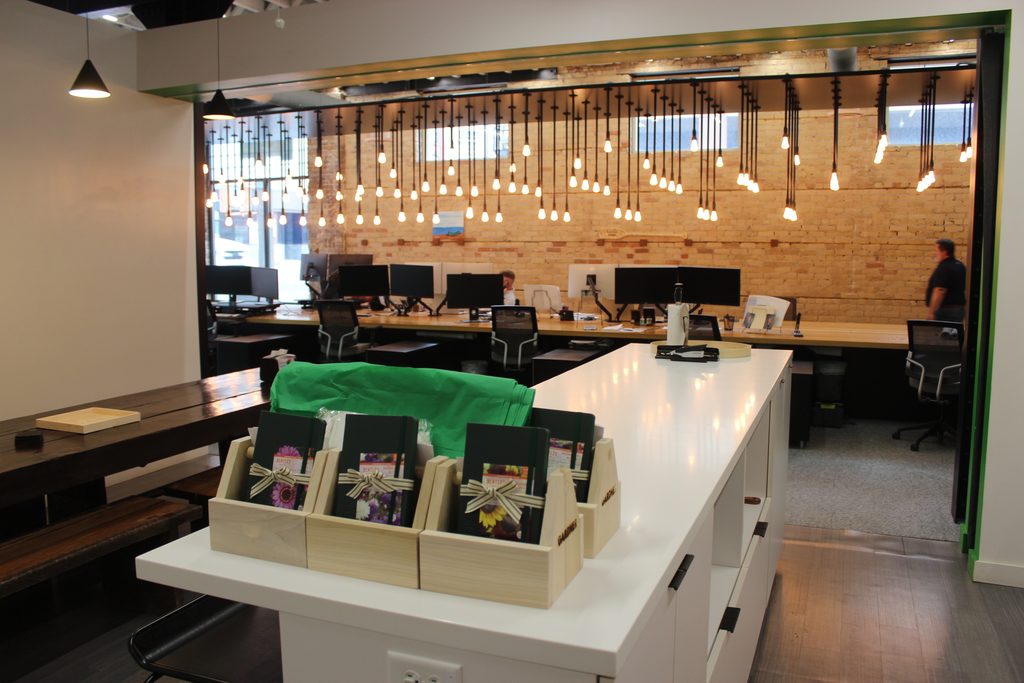
“Fun” isn’t just a bonus, for Kalina. For him, it’s a must. “I learned a long time ago that it’s more enjoyable if you truly get to know these trades on site and get to know their families,” he said. “For the last four years now, I’ve run three projects that have been 11 months to a year, and you’re spending more time with these trade partners on the job site than you are with your own families. So they become very, very important to your day-to-day life.”
Kalina said that, during his time with Gardner, the Sandstone project was “probably number one” out of all the jobs he’s worked on. “And it wasn’t just because of the trade partners we had on site, or the team that we had with the ownership and the architects,” he noted. “It was the involvement and the people in that town that I got to know on a personal basis that made it so enjoyable for me that, when I would walk into the grocery store every Thursday morning, they would call me by my name. We utilized every single business in that town that we could, and it was cool to walk into those businesses, and they knew you by your first name.”
For Gardner, they weren’t just rehabbing a long-closed structure for profit. They were helping to make a community that had welcomed them with open arms a little bit better. “When you have that kind of special treatment in a small community like that,” Kalina said, “it’s just fun to be a part of and to see how much that building meant to the whole community, to not have that building torn down and to have it brought back. The amount of people that we brought through that building that had gone to school there – it humbled me. Sometimes, we take what we do for a living [for granted].”
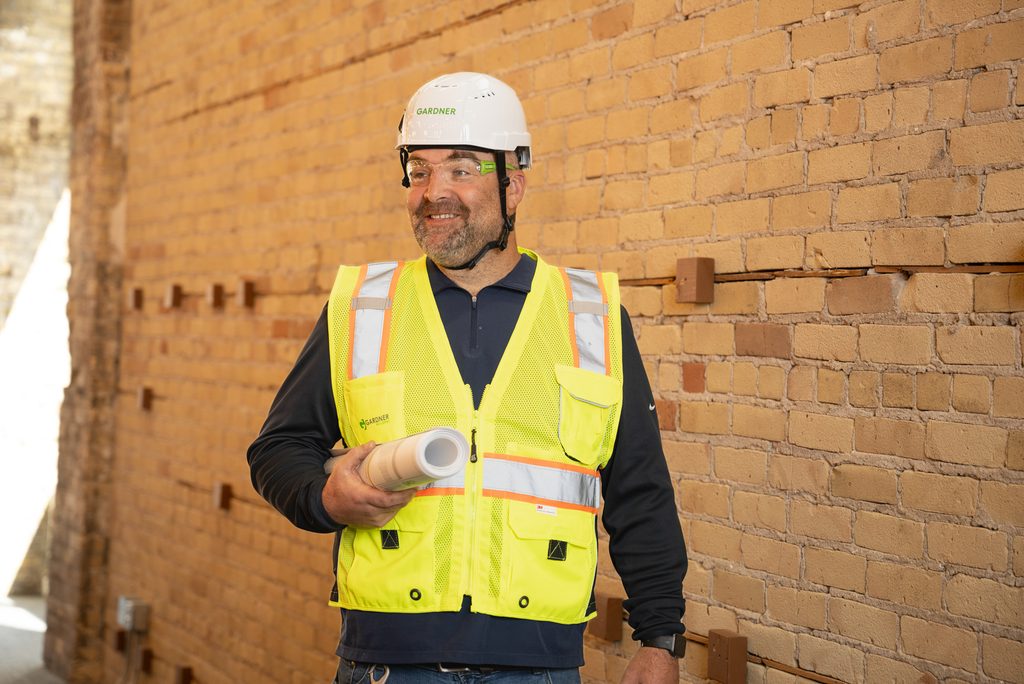
Ryan Endicott.
Field Operations Lead Ryan Endicott has been in carpentry for a couple decades, half of that with Gardner. He was recruited from his former employer, and he calls taking the job the “best decision I’ve ever made in my working career, without a doubt.”
“I think most people have a stereotype of what construction workers are – dirty, you know – you get some of those stereotypes along the way,” Endicott explained. “But Gardner brought a different lifestyle. All of a sudden, when I got hired on, it was like, OK, here’s a whole bunch of clothes. Here’s a whole bunch of nice shirts, nice polos, hats, and I’m like, whoa – in my career before that, I never had that. The office people, the laborers, the carpenters – everybody on our job sites gets these things. We look professional when we’re on the job. The culture here is unmatched. And it’s contagious. People love it.”
“It’s working with somebody, not for somebody,” Endicott said, succinctly. “It’s almost hard to explain it, because when I was here for the first couple of months, I was, like, pinching myself.”
The culture of Gardner is a big draw, clearly. One big way that they show that they’re not like so many other businesses of their size and concern is that they use simple language changes to signify how they approach things in a different way.
“There was a term that I never heard that Gardner Builders brought to the table,” Endicott said. “Typically, in the construction industry, you hear the word ‘subcontractor,’ right? At Gardner, using the word ‘subcontractor’ is like using a swear word, because ‘sub’ means that they’re below us. We use the term ‘trade partner.’ Without them, we wouldn’t be able to do what we’re able to do.”
For his part, Endicott also points to the Sandstone project as being a milestone in his tenure, but a few other names come up.
“As I was moving up in the ranks, you know, I moved around and I did some traveling for Gardner and was doing some McDonald’s projects,” he recalled. “My favorite project is a longer-term project – not having a bunch of little ones on your plate at a time – because I really like to get in and know the client and what they’re all about. Right now, it’s my projects up at UMD. I’ve been up at UMD for probably the last three or four years. They’re one of my favorite clients.”
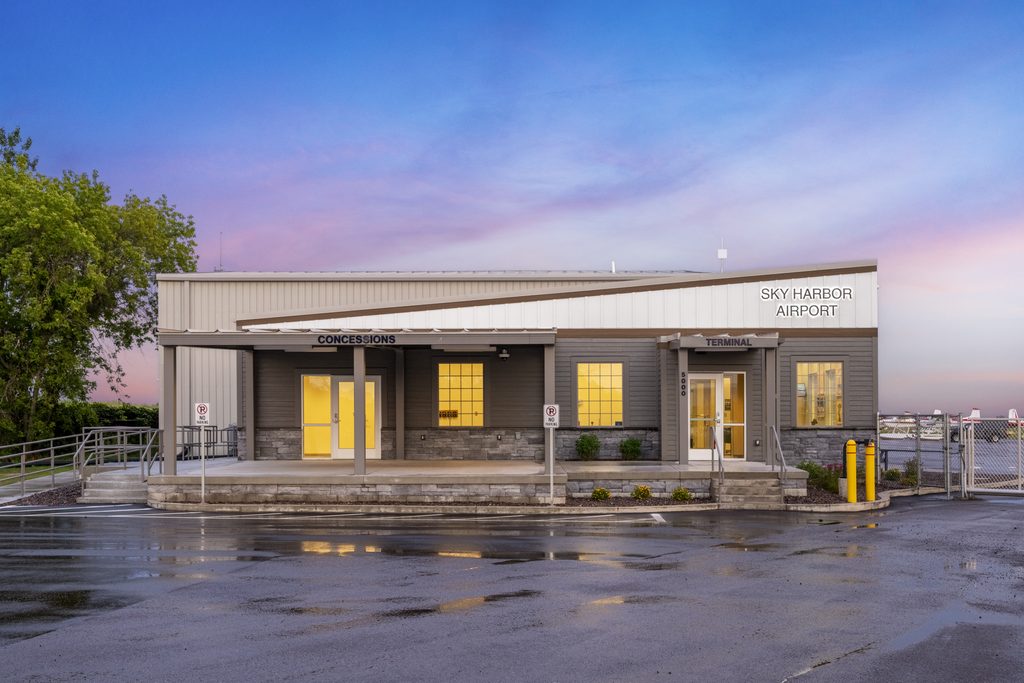
Sky Harbor Airport’s recent renovation was a Gardner project.
Alison Kimber is Senior Project Coordinator at the Duluth Gardner office, though she’s based in the Twin Cities. She’s got 25 years in the industry, five of which she’s spent with Gardner. Like her coworkers, she feels strongly about the culture at the business.
“It’s a different company, how they treat their employees,” she said. “Duluth is their own special group. I just love working with them. We have each other’s backs. It’s not just work – we love each other.”
The Duluth office’s smaller size means the group is a tighter knit, Kimber suggests. “We’re all expected to carry a different load than when you have a lot of people,” she said, “and we just don’t want to let each other down. It’s like, hey, I can see that person, they’re struggling with something. You know what? Take the day – I got this. Don’t worry. That’s a Gardner thing.”
“I feel very appreciated by my team,” Kimber said. “They’re always great at including me. I really love that part. I know what’s happening all the time, and it’s fun.”
Kimber too said that her work on the Sandstone project was particularly memorable, but an addition onto Black Bear Casino is another highlight, for her. “That was a big project. Sandstone surpassed it, but that was super fun because I felt we all kind of learned a lot working as a team together. You could count on each other. It was a great feeling.”
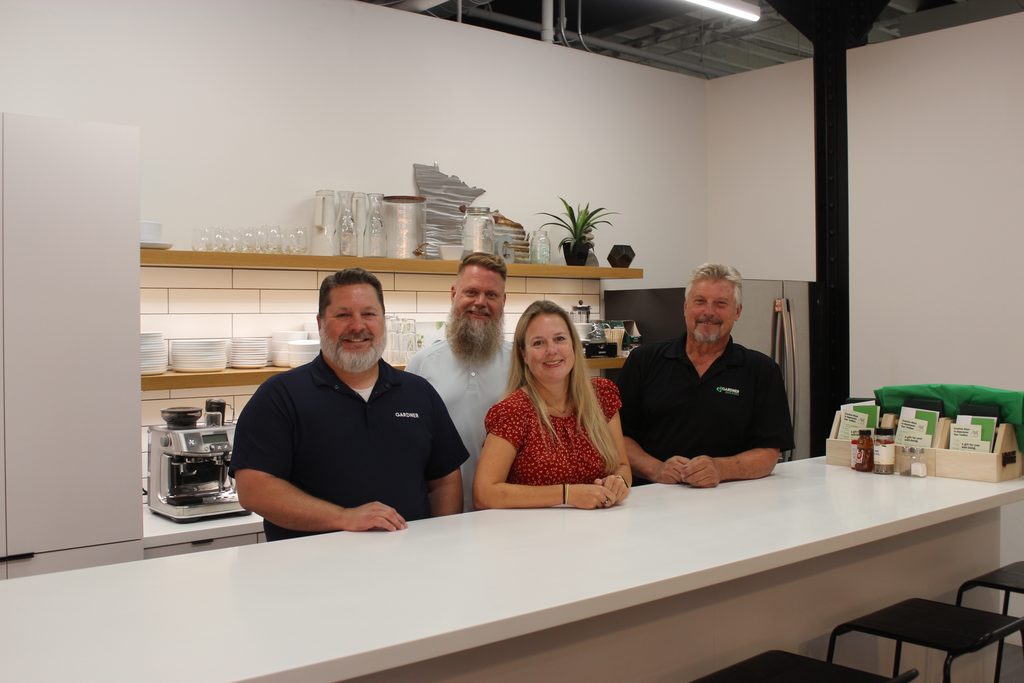
Office Operations Lead Curtis Martinson said he transferred up to Duluth from the Minneapolis office when the local branch opened in 2016. “I’d always kind of wanted to live up this way,” he said. “This felt like the best place to be.”
An early project at Wolf Ridge helped to set the tone for the company going forward. “It was just kind of a catalyst for us being up here. And hey, if we’re up here, we can probably do some other work up here too. We’re a general contractor – we can figure it out. And so it allowed us to just take on some more things. No secret sauce, no secret formula. I was just like, hey, we’re here. We might as well try to do some other things here too. And we liked it. And like I said, I wanted to be here. So it just naturally kind of happened that way.”
The company’s growth has been quick, but organic. “Gardner started with that kind of philosophy of, like, coming home excited for who you work for and not being the stereotypical general contractor and providing a better experience,” Martinson said. “And there wasn’t really that here in Duluth, we felt. It was an exciting opportunity for us to try to maybe have a little bit different recipe than some others in town. We were kind of this newer contractor coming into town, trying to just create a different experience and see if people were interested in that.”
“That was kind of what jumpstarted the whole [idea] of: maybe we can do something different and provide a better experience for people that they maybe haven’t had,” Martinson said. “Maybe it would work, maybe it wouldn’t work, but it was something we were willing to try.”
Ten years and many significant benchmarks later, it seems that the experiment has been a success. As it turns out, putting people first means happier workers, happier customers and happier communities.
“We want to show up differently for them and show them a different experience than they maybe had before,” Martinson said of his goals with the people he does work for. “I want them to call us back. I want them to feel like they’re being taken care of. Caring is really what it’s about. We’re not just here to make money – we’re here to provide an experience for somebody.”
Tony Bennett is a freelance writer based in Duluth.