To suggest that the Whole Foods Co-op sprang from humble beginnings doesn’t do justice to the Duluth grocer’s history. It started in 1970 when 20 likeminded folks formed the Whole Foods Buying Club, which operated out of the basement at the communal Chester Creek House, located at 13th Avenue East and Second Street.
Fast-forward 55 years, and it’s a highly sophisticated operation with two Duluth locations, 150-plus employees, about 14,000 owners and more than $22 million in annual sales. Along the way, there were moves (around the Hillside neighborhood), mergers (with other buying clubs and co-ops) and marked growth. What didn’t change was the enormous amount of interest in the natural, locally sourced products sold at Whole Foods. They elicit a zealous following.
While the Co-op’s start was modest enough, its founders’ ambitions were anything but. Food was a vehicle to something bigger.
“In the beginning, a lot of the motivation was to change the world,” said Margaret “Margi” Preus.
Her husband, Arno Kahn, agreed. Both have been involved with the Co-op since the early years.
“That was the draw for me – social change,” Kahn said.
Kahn was more of a supplier at the outset. He started the Common Health Warehouse to stock co-ops across the region as they gained in popularity. It’s always been about community, empowerment, about people doing things together for the benefit of all. That is largely what has spurred the Whole Foods Co-op’s success. As a community-owned organization, when it does well, it uplifts everyone.
For $100, anybody age 18 and up can invest in the business and become an owner. It’s worth noting, though, that ownership isn’t a requirement to get in the door.
“You do not need to be an owner to shop here,” marketing manager Jenna Kowaleski says. “Everyone is welcome at Whole Foods Co-op.”
Whole Foods opened its Hillside location (610 E. Fourth St.) in 2005 and a second store near Denfeld High School in 2016. Incidentally, it was Kahn’s construction company, Builders Commonwealth, that renovated the Hillside property for Whole Foods, which in 2006 became the first LEED-certified co-op in the country. LEED stands for leadership in energy and environmental design.
That dedication to sustainability carried on at the Denfeld site, which features an array of about 140 solar panels. Not surprisingly, the panels were assembled locally, in Mountain Iron.
This year – which just happens to be the International Year of Cooperatives as announced by the United Nations General Assembly – marks its 55th anniversary. Foundational to the Co-op’s rise has been a willingness to adapt, to try new things. That has helped to avoid stagnating. Staying fresh keeps people engaged.
“Our Co-op has consistently not been afraid of growth,” says Sarah Hannigan, Whole Foods general manager since 2016 (she managed the Hillside store prior to that). “We have consistently seen the value in growing. It’s not just for the sake of getting bigger; that growth allows us to make a bigger impact on our community.
“We’ve evolved over time.”
Hannigan took over as general manager for Sharon Murphy, who was an early member before becoming one of the Co-op’s first employees and, ultimately, its GM for more than 35 years.
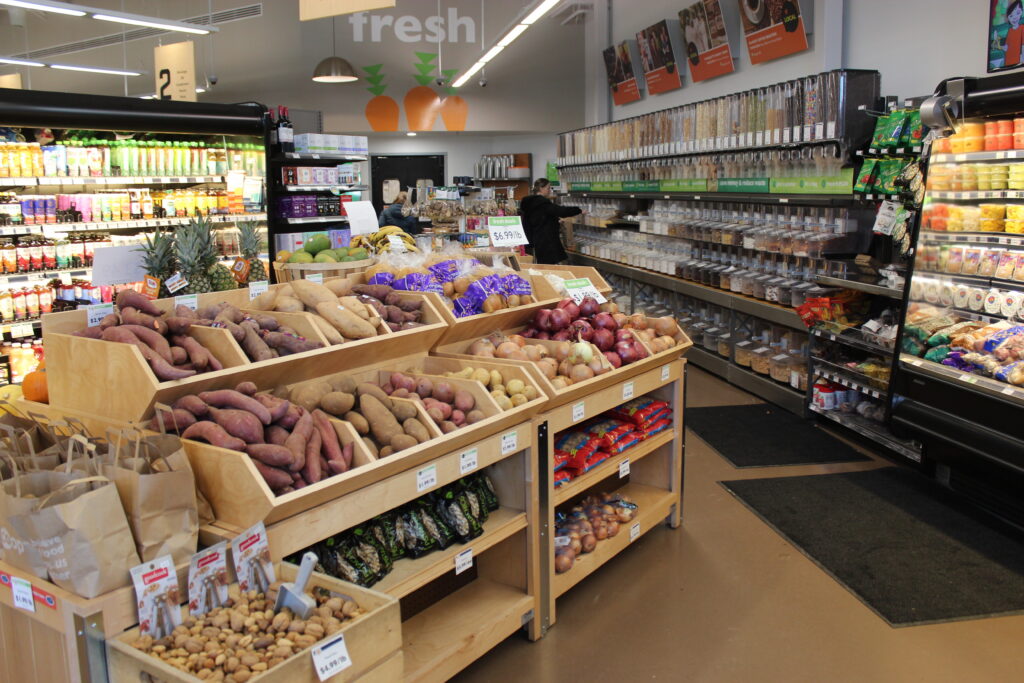
For Hannigan, it all goes back to the founders, who were committed to organizing for the greater good. They stressed local, which remains a North Star today. There’s a steady stream of area makers, who routinely stop in to drop off their goods. In 2024, Hannigan says Whole Foods purchased items from 170 independent vendors to sell in-store. They work with cheese makers, egg producers, bread bakers, carrot growers and myriad other creators, including one who makes cat toys out of recycled wool sweaters.
There really is something for everyone.
“We have this commitment to local vendors, local community members, and buying directly from them,” Hannigan says. “It’s a big investment to support the local economy in this fashion, and it’s critically important to us.”
Since joining the Whole Foods Board of Directors, Maria Isley has obtained a broader perspective of just how significant that commitment is. The Co-op allows consumers to prop up local producers by purchasing their goods. As Isley says, there are a million choices when it comes to something like buying carrots. Getting them at Whole Foods is a way to ensure they are locally made, and that locals benefit.
“When we’re able to make a decision with that mindset, we can be more intentional,” says Isley, who just finished her term as board president. Being able to support a local farmer and his or her family, as opposed to buying from a faceless billion-dollar corporation that sends the money to some faraway place, “makes it extra special.”
“It goes back to where is your dollar going and who is it supporting?” Isley says.
Isley used the word “collaborate” several times, as in collaborate with community partners to better leverage resources and maximize positive impacts.
“There’s something deeper that these co-ops offer; it’s not just about food,” she says. “In a time of abundant consumer choices, it’s empowering to know that Whole Foods Co-op is more than just a grocery store – it supports regional farmers, producers, businesses and nonprofits. As a business, it promotes sustainability, energy efficiency and increased access to healthy food. For more than 50 years, its commitment to sustainability and cooperation has helped it thrive for its owners and the broader Duluth community.”
In May, Duluth and the Whole Foods Co-op will host the Consumer Cooperative Management Association’s annual conference at the DECC. During three days, they will welcome as many as 400 co-op leaders from around the country. Part of the itinerary will involve attendees touring the Whole Foods locations and examining the local food system, which will highlight growers and food producers from around the region, people who have to be diligent while making the most of our short seasons.
“It’s a real honor for us to be able to host co-op leaders from all across the country,” Hannigan says.
It’s a pretty big feather in the cap for something that started as a quaint buying club in the basement of a house.
Of those first 20 members, Hannigan says: “It was people just figuring stuff out. They were ambitious, industrious and really committed to their community.”
Community first and foremost
The legal name is Whole Foods Community Co-op Inc.
“Community really is our middle name,” Hannigan jokes.
While there are a plethora of activities to elevate people and organizations across the region, two of the biggies are the Community Support Program and Grow Local Food Fund (GLFF). Both are funded through Whole Foods’ round-up-at-the-register program called GIVE. The idea is straightforward – shoppers can round up their purchase to the next dollar, and the excess goes to the program. The small donations add up quickly.
Since 2017, GIVE has raised more than $850,000. Initially, it was only offered one month a year. But it became too popular to keep dormant the other 11 months.
“Our shoppers and staff were like, ‘Why aren’t we doing this all the time?’ ” Hannigan says. “Customers love it. It’s a great way to raise funds and to raise awareness.
“We like to say small change, big impact.”
For the Community Support Program, donations are made to a new nonprofit each month. Past recipients include Men as Peacemakers, CHUM, Life House and numerous other important organizations hellbent on making life a little easier and a little better for folks in our community.
The GLFF is more targeted, specifically looking for “projects that build the resiliency of our local food system.” It focuses on “emerging growers, emerging food producers, established growers and established food producers in our community.” This would make sense, of course, considering Whole Foods’ reliance on local growers. The goal is to enhance access to healthy natural foods.
The Co-op is on track to dole out about $55,000 to local growers and farmers this year. Funds are distributed in March so they can be used for the upcoming growing season.
“The program is great because it gives a leg up to local producers and farmers,” Hannigan says. “We really want to connect and support that local food system in a meaningful way, and the Grow Local Food Fund lets us do that.”
Farmers use the grants for things like equipment, infrastructure and technology, enhancing productivity and, therefore, access to food. One of Whole Foods’ big vendors, for example, applied for a grant to purchase a machine that removes the tops from onions. They had been doing the tedious process by hand; the new equipment boosted their productivity. Another farmer used a grant to nurse an unhealthy plot of land back into production.
“It’s a variety of things that get funded through this program,” Hannigan says. “But it all ties back to growing food and producing food locally.”
Community engagement and support goes beyond grantmaking. Visit either of the Whole Foods locations and you’re struck by the vibrant, diverse collection of artwork on display in the seating areas. Whole Foods chooses new artists to feature each month, including, occasionally, owners and staff members. Recently, organizations such as the Duluth Art Institute, Choice Unlimited and Northern Expressions Arts Collective have submitted pieces by their members, including youth artists.
Local artists, many of whom don’t have an abundance of options for showing off their work, appreciate the visibility.
“People are excited about it; we’re booked out months in advance,” Hannigan says. “We have some artists that are established and well-known and some artists for whom it’s their first show ever.”
Speaking of regional artists, a few of the better-known features at the Whole Foods buildings come from locals. They include the blue glass murals and stone mosaics at the Hillside store, created by Ron Benson and Laura Stone, respectively, as well as a beautiful pastel production at the West Duluth location, done by Carolyn Olson.
It’s part of a concerted effort to build connections with the creative community, as Hannigan says. It’s also about supporting people who support the Co-op, which has been a guiding principle going all the way back to the very beginning.
“Community has always been a big part of what we do and who we are,” Hannigan says.
More demand, more competition
Interest in organic food has skyrocketed, fueling a dramatic increase in sales. They more than doubled from 2013 to 2023 in the United States, climbing from just north of $30 billion to $63.8 billion, according to the Organic Trade Association (OTA). The increase is a good thing for the Whole Foods Co-op and others like it, of course. But there’s a catch. The popularity prompted more competition.
Traditional grocers and big-box retailers wanted in on the craze and started carving out small sections of space for organic food and beverages. Now? It’s everywhere. In fact, by 2020, conventional grocery stores, club stores and supercenters were responsible for a majority – 56% – of the organic food sold to consumers in the U.S., according to the OTA.
Until about 2013, Hannigan says, Whole Foods was “really the only game in town for organic, gluten-free, natural foods.”
Despite the industry’s changes, the Co-op hasn’t strayed from its roots.
“The thing that really differentiates us is that we truly remain local and we truly have stuck with this community ownership model,” Hannigan says. “And we are committed to continue serving our community.”
An important element that has helped Whole Foods navigate the uptick in competition and continue to grow is its affiliation with National Co-op Grocers (NCG). The NCG acts as a virtual chain on behalf of a large number of cooperatives and is able to negotiate discounted prices because they’re buying in bulk.
“It’s been very instrumental for us in growing the way that we have and being able to better serve our community,” Hannigan says.
It’s a community that appreciates the goods sold at Whole Foods, the quality and the camaraderie of sharing a collective purpose.
Early on, “I think there was a lot of interest in the concept of a co-op and in eating healthy foods,” Kahn says. “It’s worked out well up here in our little universe because people are interested in that sort of thing.”
Louie St. George III is a Duluth-based freelance writer.