Phase Two Includes New ICU and Cardiac-Care Unit
By Tony Bennett

The last few years have seen a huge change in the landscape of the local health care industry, both figuratively and literally. It’s easy for longtime locals to drive around the downtown area and take note of the many hospital-construction projects that have reshaped the Duluth skyline, but when it comes to what’s going to be happening in those buildings, those processes often take place in phases through a number of many years.
At the recently rebranded Aspirus St. Luke’s, the health care providers are about to put the finishing touches on the second of a three-phase construction project that will mean major positive changes for doctors, nurses, support staff, patients and the families and friends of those patients.
As is the case with any building or structure in any field, with time comes challenges, ones that were often not anticipated by builders of decades past. In the ever-changing, fast-paced world of health care, patient needs, technological upgrades, workflow and myriad other things must consistently be upgraded and adjusted. The new work that is about to be unveiled at Aspirus St. Lukes will ensure that the hospital can grow into the future and their work can remain cutting-edge.
The Health Forward Initiative is a $318 million project in three phases that is now, with the completion of its second phase, headed into its home stretch. Phase two boasts innumerable smaller tweaks and changes right alongside big-headline ones like a brand-new ICU and cardiac-care unit, as well as a new helipad and parking ramp. It’s just about 83,000 square feet of vertical expansion to their Building A, and it’s cause for a lot of excitement among those who have devoted their lives to helping others.
It’s called the “Health Forward Initiative” for a reason – these changes will allow for better, faster health care responses from those who take care of people who are often experiencing one of their worst days.
Julie Clark is Director of Cardiac Services at Aspirus St. Luke’s. She’s been there about 35 years, holding numerous positions. Since taking on her current role a few years ago, she got a good sense of what positive changes were just around the corner. “I oversee the cardiology clinic, the procedural areas, the inpatient unit, the cardiac diagnostics and the cardiac rehab spaces,” Clark said.
With such a complete overview of that department, it was easy for her to see how monumental the Health Forward Initiative would be for her and her coworkers’ day-to-day responsibilities.
“First,” Clark said, “the Building A space opened up with a new ED (emergency department) and OR (operating room), and in that OR space was lots of new technology – an EP (electrophysiology) lab, a hybrid room, different things – and then the next phase was, the first floor became cardiac services outpatient, cardiac diagnostics, stress testing, all those things. A new cardiac rehab area. New cath labs. This, then, now moves the inpatient cardiac unit up to the 7th floor and the ICU (intensive care unit) to the 6th floor, so centralizing all that stuff [was key]. If you think about the patient that comes through the ED, goes to the cath lab, then up to the ICU – the flow is very seamless.”
“The helicopters are right on top of Building A,” Clark continued. “It’s very fast. We’re all kind of situated in the places that we need to be. Even having pulled the stress labs out of our Lakeview building years ago over to this Building A has been a real positive movement, just putting people together.”
That’s the key refrain that all involved seem to repeat – the construction project is all about making the sharing of space easier, whether that’s doctors or nurses having new, more-open spaces in which to commune, or if it’s families now being able to comfortably gather around an ill person in support. The goal was to make it easier to join together in physical spaces and not have as many impediments along those lines.
Clark said, for example, that having the ICU more integrated will be a big plus. “It’s not cardiac-related, but it is important for them to be close to that ER and all the things we do over in this building,” she remarked. Another selling point is the addition of larger, private rooms for patients.
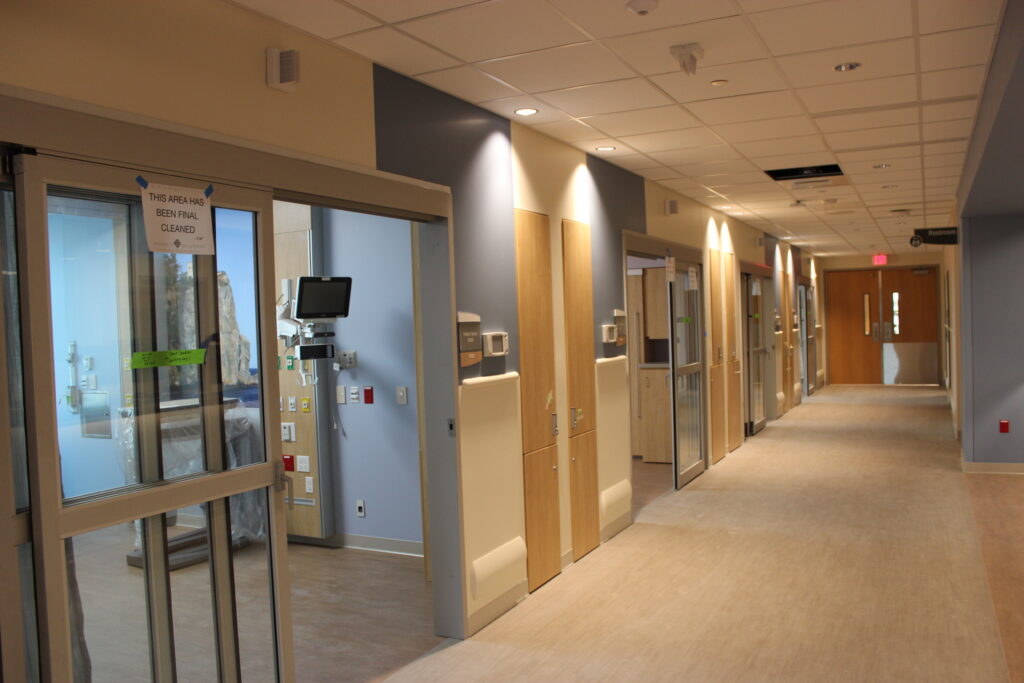
“What we wanted to do is,” Clark explained, “we knew some of the inefficiencies of our current space and the rooms were small, and they didn’t offer the staff and the patients the footprint that they needed. So we did some visits to other organizations and collected ideas and listened to architects and we knew that we wanted bigger patient rooms – something that would accommodate the families more comfortably – and a good amount of built-in space for supplies, so that staff are not running around trying to get the things they need. They’ll have everything at their fingertips. And we also knew on the cardiac unit that we wanted technology in the room. So if the patient becomes more critical – as they can in our unit – we have everything there that we need, so the room can be low-level or high-level. And so that’s exactly what we got.”
“I would have to credit the executive team for having the vision of where they wanted to go with these construction projects and the improvements that we needed to make as an organization and how they tiered them,” Clark said of how well the phases have unfurled, thus far. “[The early] building really optimized our surgical services area and our ER – it was a tremendous improvement for them. I’m a bit siloed into my cardiac-service world and I know what I want and need, but there’s a whole organization that looks at everybody and decides where the greatest need is. We all sort of say ‘this is what we need’ and then it’s up to them to decide what’s the best path for the organization and what services we move.”
Being that Aspirus St. Luke’s has always stayed on the cutting edge of technology, the build hasn’t necessarily meant that they can suddenly use tech that they couldn’t use, before, but what it does do is make it easier to use said tech.
“Right now,” Clark said, “we have the technology to do the things we need to do, but you have to bring in an extra monitor and do those kinds of things. Now, we have a bigger room, and it’s all just built-in, there. You use it when you need it. You didn’t have that option in shared rooms and small spaces.”
ICU manager and Critical Care Education Coordinator Brittney Kurhajetz has been at the hospital for 17 years and started as a bedside nurse in the wing she now oversees. She too sees this latest phase as being significant.
“Our ICU was split between two floors,” she said, “but it had the same staff. So we had a charge nurse going between two units. We had the need for more beds.” Now, they’ll have 28, and they’ll all be on the same floor.
Having everything on one level helps save precious minutes. Cutting down on transport time within the hospital could be crucial to a patient in the middle of a serious health event.
“If a patient is having a heart attack,” Kurhajetz explained, “they can go down to the cath lab and come up in the same elevator to the ICU. If they need to go to a higher level of care, we can take that same elevator right up to the helipad. Having all the critical-care areas close together is really exciting.”
“We have overhead lifts in the ceiling in every room,” Kurhajetz said, “which is great. If a patient, mobility-wise, isn’t able to get up, that equipment is there. It’s easier on our staff. It’s easier on our patients. We can get them up and moving, and it decreases the length of stay for that patient – what we call ‘ICU liberation’.”
The list of amenities goes on. Many of the changes are quite simple, but one can imagine how helpful they’ll be as part of an overall experience.
“One of our night nurses said, ‘You know, coming in to assess the patient at night, you don’t want to turn a bright light on’,” Kurhajetz said. Now, instead of blasting a sleeping person with light and disturbing their rest, dark red lights have been installed, which should go a long way toward solving that issue. “I can see the patient, but I’m not turning a bright light on and waking them up in the night,” Kurhajetz said.
“A neat thing that we also have is in our bathrooms,” Kurhajetz said. “Most of our patients are pretty sick and unable to get up to use the toilet. So, all of our [new] rooms have a bathroom, but it doesn’t have a toilet in it. It has a hopper in it. If a patient’s using a bedpan or a commode or whatnot, we can clean those things right in the room. We’re not walking through the hallway with that, which is huge.”
Scott Mikesell is Medical Director, Cardiovascular Services and Cardiac Catheterization Laboratory and Interventional Cardiologist at Aspirus St. Luke’s. He too is very much ready to show the public just what has been going on.
“There are layers to this,” Mikesell said. “The infrastructure of the main hospital is aging, and so bringing this floor up to state-of-the-art is paramount to being able to take care of our patients. How we deliver our care has evolved and continues to evolve very rapidly, and so, to be able to modernize and open a pristine floor like we’re going to be able to is a phenomenal opportunity for all of us and specifically for our patients and their families.”
“The consolidation of the cardiac care at Aspirus St. Luke’s into one building basically is a tremendous bonus,” Mikesell said, “because, with the cath lab being on the first floor, as well as our diagnostic services – the ER, the OR, the ICU and the cardiac floor – we’ll rarely have to leave the one building to take care of our patients. Our patients have a very short distance to go. The efficiency of care escalates tremendously, compared to what we’re doing right now. Certainly, health care architecture has changed since the whole hospital was built, and so we’re retrofitting modern-era health care into an older building. Now, we don’t have to do that.”
Mike Boeselager, Vice President of Support Services at Aspirus St. Luke’s, has had a significant role in the planning and construction phases of the Health Forward Initiative. All along, he said the whole enterprise was patient-centered, but that it also involved all stakeholders from the laundry folks on up the ladder. The idea was to make sure that everyone got what they needed and the workflow made sense for everyone. The team went so far as to build an actual-size physical model of the planned ICU, so people could actually experience it before it was finalized.
“We built a mock-up ICU and the CCU in the parking garage of Building A out of plywood to the architectural dimensions,” Boeslager said, “and then we invited all of those stakeholders to do a walkthrough, and they went through it many times and even put sticky notes on the wall.”
Boeselager said a number of local contractors were involved with the second phase of the Health Forward Initiative. AW Kuettel & Sons, Hunt Electric Company, Jamar Company, Johnson Wilson Constructors and St. Germain’s Cabinet were just a few of the names involved. “We generally use the same trusted partners that we have in the past,” he noted. “There’s a few contractors that simply don’t reside here in Duluth. But for the most part, they’re really the local team – the crew that we’ve relied upon through all our projects. We wouldn’t know what to do without them. They help maintain our facilities, aside from building them. They’re here all the time on our campus, helping with projects or maintenance.”
Overseeing the project was a team from Erdman, a Madison, Wis.-based architectural firm with a national reputation for health care and senior living projects.
“We’ve been partnered with Aspirus Saint Luke’s for 15 years, going back to the planning of building A,” said Erdman Project Manager Neil Bright. “We’ve been a part of their master planning, so we have a real good familiarity with what they’re trying to achieve and what the surrounding neighborhood is. So that’s been very fortunate, that we have that trusted partner that trusts us.”
Bright noted that a project of this scope requires other partnerships as well.
“There are a lot of pieces to the puzzle,” he said. “We were meeting with the City of Duluth and with Aspirus Saint Luke’s during all the planning meetings because the city wanted to be very much a part of that. I told the Plan Commission when I was in one of the meetings, ‘We consider ourselves as much a partner with the City of Duluth as we are with Aspirus St. Luke’s.’ It’s just been that kind of a working relationship to help bring these projects to fruition.
He said perhaps the biggest challenge was designing a construction project for a working hospital.
“From a design standpoint, you have to come up with a solution bridging these construction projects while keeping the hospital operational,” Bright said. “How do you do this in a way that when they get done they can move out of their old facility and into their new facility without really losing any productivity or revenue? That’s essentially what you’re trying to do in an overall sense from construction. You’re in a tight downtown site which doesn’t offer a lot of space for staging of materials, for putting up a crane. We had to kind of block streets and reroute things, which when you have an emergency department in your facility right now, all of a sudden we’re taking roads and we’re blocking them off. We had to temporarily change some one-way roads to actually go the other direction to allow ambulance traffic to get to the ED. So, there’s a lot of logistical issues for construction. And then throw into that mix, you get these cranes to go up 8 floors and we have an existing helipad that’s essentially at the 3rd floor. And you have to be in coordination with the hospital so that the hospital can let us know when a Med flight is on the way, so that we have 10 to 15 minutes to get the crane down and out of the way, or to make sure we have the crane in a position that it’s not in the way.”
Originally, the new areas were meant to open at the top of January. Construction delays have pushed that back, a bit. Currently, the plan is to open the cardiac unit to the public on January 28 and the ICU the next day. Regardless of the opening date, these new facilities will serve the people of the region for years to come, and will significantly improve the way health care professionals do their jobs. It’s been a costly project, and it has another phase to come, but the list of positive changes is already quite long, and all involved are looking forward to putting the health of people in the region forward in a whole new way.
Tony Bennett is a Duluth-based freelance writer