The Lakeview Proudly Represents a Commitment to the City’s Future
Downtown Duluth continues its burst of vertical growth in recent years with the addition of The Lakeview at 333 E. Superior, a brand-new housing development located right across from the new Essentia Health hospital and built by the same company that tackled that $900 million job.
The building, a mixed-use, 15-story project that is about to open its doors, blends long-term apartment living, extended-stay spaces, street-level commercial spaces and a high-tech gym area to create an ideal place for those who are, say, visiting family at Essentia, house-hunting for months on end, or who are just looking for a great apartment with lake views and yoga classes only steps from their door.
While the housing crisis is still very much ongoing and affects people across economic strata, The Lakeview is a huge step in a positive direction. It will be able to house hundreds of people both long- and short-term, and it will contribute to the City of Duluth’s stated mission to make more living spaces in the downtown area.
Stuart Zadra is a partner and Executive Vice President for Landmark Development who spearheaded the Lakeview project. He’s been with that company for nearly 30 years, and he’s worked on the U.S. Bank Stadium and Lambeau Field, among many other massive projects in his time. He’s learned through the years to not just look for the big-ticket construction opportunities, but to also be watching for smaller opportunities that would pair nicely with them.
“Lambeau Field has an area surrounding it called Titletown,” Zadra said, “and not only did we do redevelopment on behalf of the Packers, but we looked at ways to further advance and increase revenue, and that was in creating an entertainment district. So, often, there’s a catalyst in real estate that can drive further growth in the marketplace of different components of real estate. In this case, it was our involvement with Essentia Health that really piqued our interest in opportunities in Duluth.”
As it turns out, the recent reinvestment of Essentia into the downtown area directly inspired the building of the Lakeview.
“Viewing what Essentia brings to the market, and Aspirus, as well as other businesses in the area – they’re drivers of economic impact,” Zadra said. “It’s how we measure opportunities. And we saw that the strong employment base, the investments being made by both medical providers, and thinking about [how] there’s been, in the press, much discussion about a medical college – that really piqued our interest in doing more, and we hope to do more beyond The Lakeview, as well.”
As the owner’s rep on the Essentia build, Landmark Development got a great education in the local market, and they found themselves seeing opportunities they hadn’t necessarily planned for.
“We came to Duluth in 2018 or 2019,” Zadra said. “We studied it for a long time, and then looked at the opportunities and saw the Voyager” – the Lakeview now stands on the footprint where the former Voyager hotel existed – “would be a great first project for us beyond our work in the health care field.”
Once the firm acquired the Voyager, they “went ahead and studied and really came quickly to learn that there’s a shortage of housing, quality housing, in the marketplace,” Zadra said. “You study the market and there’s limitations on overall development height and, you know, other measures and footprint. That’s how we landed on the 210-unit project with approximately 20,000 feet of commercial space.”
Like many apartment projects these days, the Lakeview will have commercial storefront space on the bottom and then living spaces above.
“That changed a little bit over time,” Zadra said. “We’d looked at doing apartments and some townhomes. That didn’t really make a lot of sense. They’re expensive to build. And we solidified the opportunities in the commercial space as we advanced.”
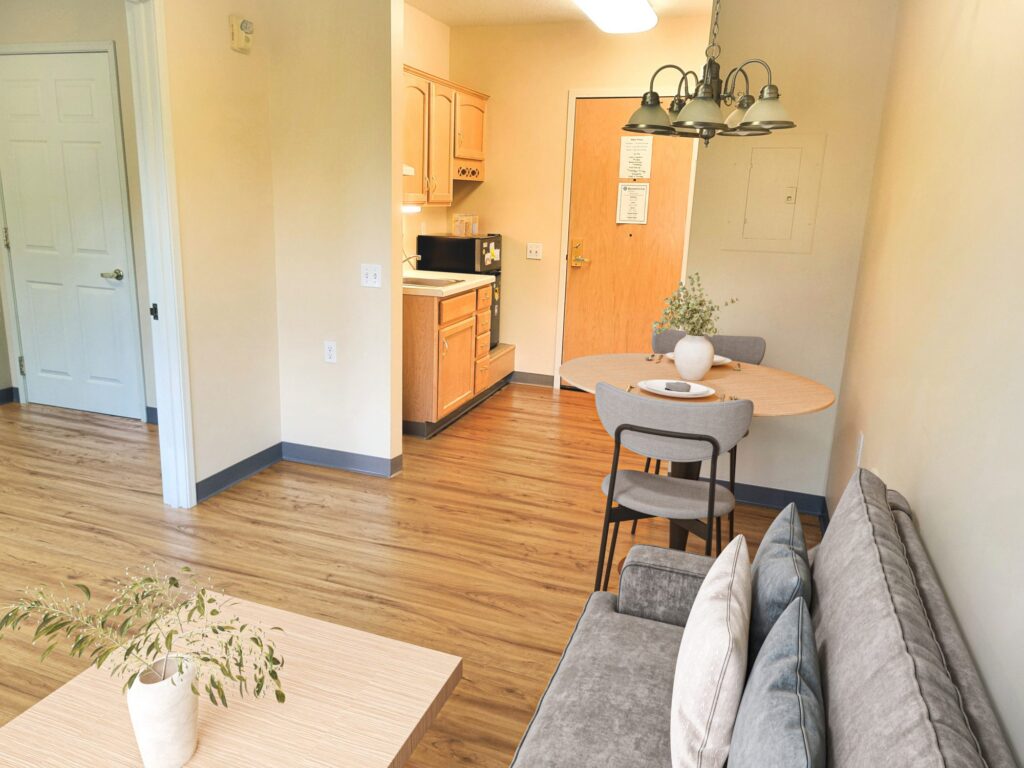
Early plans leaned less into the extended-stay spaces, but that number grew with time. “With the employment base,” Zadra said, “there’s a number of people that are traveling support – whether they be radiology, nurses, doctors – I’ve bumped into them quite a bit in the city that travel from around the nation. In the medical profession, it’s not unusual for somebody to come in for a two- or three-day stint and head back to their home base or spend two weeks and turn around. And oftentimes, those people want to have something that feels more permanent. And so, when they get a fully furnished extended stay, that feels a little more like home than living out of a suitcase.”
Then there’s the people who want to live permanently in Duluth but find it difficult to find the right house. With extended-stay options, this process becomes easier. “In Duluth,” Zadra mused, “there’s really a challenge on housing for others looking for some time period to get to know the market, to wait until something is available that they can get at the right price – this helps fill that void.”
The building, which cost upwards of $75 million ($7.5 million of which came from TIF funds from the Duluth Economic Development Authority), went up with a minimum of surprising challenges, especially given the lay of the land.
“Working in any location where there’s bedrock, you’re on a side slump, you’re working downtown – we had to figure out the logistics with our contracting partners on how to deal with that,” Zadra said. “We expected bedrock, given the work that we did at Essentia. We probably came across slightly more, but not greatly more than we anticipated.”
“In the shorter timeframe to build this building than Essentia,” Zadra noted, “we had many more weather impacts – that is just the nature of the beast. Something you just can’t control.”
Site logistics also proved challenging. The Lakeview’s location was a “very tight site, shrouded on two sides by roads, and then a parking structure and an existing building. Fortunately, the city was cooperative.”
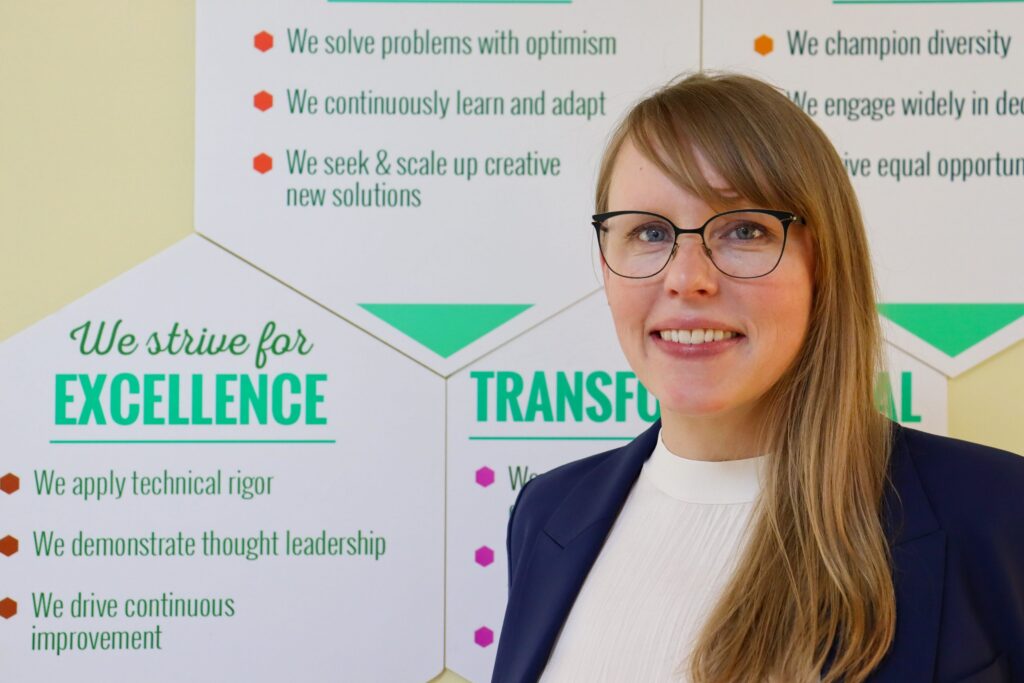
Amy Supple is Senior Vice President and Chief Operating Officer for the Edgewater Hospitality Company, which runs the hotel of the same name in Madison, Wisconsin. She and her management team have been tapped to oversee floors 2-4 in the Lakeview, which includes the wellness facility and extended-stay rooms in the building.
“It happened about a year and a half ago,” Supple said. “We were looking at different opportunities for us to expand, and got up to Duluth and honestly, I just kind of fell in love with the city. I think it’s fantastic. I love the energy of the city. You can feel that the city is going through this renaissance. There’s a great commercial boom that’s happening. And the local tourism base makes it a really attractive city to do something like we’re doing.”
Supple touts the building’s wellness component as being a big one, and she expects it to be a huge draw. “So much of health care is turning to wellness and lifestyle,” she said, “and the ability to have this kind of a facility right next door to Essentia, I think, is just a great proximate use to everything that’s happening. There’s a really interesting medical district happening here, and we think the wellness component fits really well within it.”
More than just a small hotel-gym-style space with a few machines, the Lakeview’s wellness center is a key selling point for the building, and it will likely also be a community meeting space for people who don’t even reside in it.
“Every community in the country is talking about these lifestyle buildings that are focused on wellness,” Supple suggested. “People are just living differently, now. They want to have more facilities. They want to have programming within the facility that’s not just a party but is focused on building community around active lifestyles. I think Duluth is the perfect city for that, because it is already a community that’s very focused on active lifestyles. It really fits well with the culture here to do something like that.”
“It’ll be much larger than what you would get in your normal apartment building,” Supple continued. “The whole facility is over 9,000 square feet just on the inside, and part of the outdoor courtyard is being used for the wellness facility, as well. We’ll have state-of-the-art equipment of varying types – everything from strength training to cardio to ergonomics and things like that. We’re doing the programming for group class spaces. We’ll have some of your traditional classes, but then we’re also going to do express classes, so people who are working downtown who want to come and just get a quick intensive workout during the day can do that and then get back to work – on their lunch break or within the hour that they might have to do that.”
“And then there’s a big thermal component as part of this, too,” Supple said. “In addition to being a really state-of-the-art fitness facility and gym, we’re doing two saunas with Cedar and Stone, cold plunges, experiential showers and some other thermal elements that will add to the experience.”
Christopher D. Woodfin is Senior Associate with Pappageorge Haymes Partners. Woodfin designed the building and has been back to Duluth on about a monthly basis to monitor its progress. For him, it’s been a project that slots in nicely with others of the sort he’s worked on in recent times.
“Primarily,” he said, “as architects, that’s what we do. We’re multifamily residential architects. We do a range of building types from high rises and mid-rises to townhomes.”
Woodfin said his early design was an “all-glass building,” but a desire to make the project greener led to changes.
“Over time,” he explained, “looking at energy and sustainability issues and how we could make the building better thermally brought us to introducing these precast facade panels on Superior Street, and then even more so on the backside.”
Other tweaks from his early drafts includes the addition of an outdoor terrace that Woodfin was inspired to add by stories he had heard of the Voyager Lakewalk Inn being a great place to watch Grandma’s Marathon.
“You can be there, you can stand in that area, and you’re also covered by the building above,” he said. “There’s tables, there’s grills out there. And you have this amazing view of Lake Superior, even on the second floor.”
Chris Adatte is the owner of A.G. O’Brien Plumbing and Heating Co., one of the local contractors who worked on the Lakeview. (Others included Northland Constructors, Hunt Electric, Bedrock Flint, Donlar, SVL and Wells Concrete.) Adatte said he felt the project was a worthy one to join.
“As a company, we had not worked with Landmark Development before,” Adatte said. “We were aware the project had gone through several rounds of pricing to bring costs into alignment. We participated in one of those early pricing exercises by teaming with another contractor to help price the project. Later, we approached (construction manager) CG Schmidt with our own team to see if we could help move the project forward and get it off the ground.”
“I initially helped bid the project and later worked on value-engineering the mechanical design to bring it to a feasible budget so construction could proceed,” Adatte said. “Beyond our insulation subcontractor, Northern Industrial Insulation, and our preferred wholesalers, the general contractor hired out the remaining scopes. In total, we had roughly 30 people involved in the project, both in the field and in the office.”
In his mind, Adatte doesn’t just help build projects, he helps to build the city of Duluth.
“The Lakeview 333 project is a catalyst for the downtown transformation Duluth urgently needs,” he said. “It introduces a modern, beautiful housing development to the lakefront – strategically and appropriately-placed next to the new hospital. It signals that Duluth is ready to modernize, attract new residents and grow its tax base. We’re genuinely excited to be part of a project that marks a turning point for the city and contributes to a stronger, more vibrant downtown.”
“The project has not been without its challenges, particularly in navigating the collaboration between the public and private sectors,” Adatte noted. “Both sides have had roles to play in the obstacles that needed to be addressed, and it has taken a collective effort to keep the project moving forward. If Duluth wants to attract continued investment – especially downtown – communication and accountability on both sides must come into sharper focus. Predictable risk is the single most important factor in encouraging developers, contractors and investors to commit to future projects. When that happens, it leads to more jobs, more housing and long-term benefits for the entire community.”
Tony Bennett is a freelance writer based in Duluth.