Hello, Twin Ports Interchange
By Tony Bennett
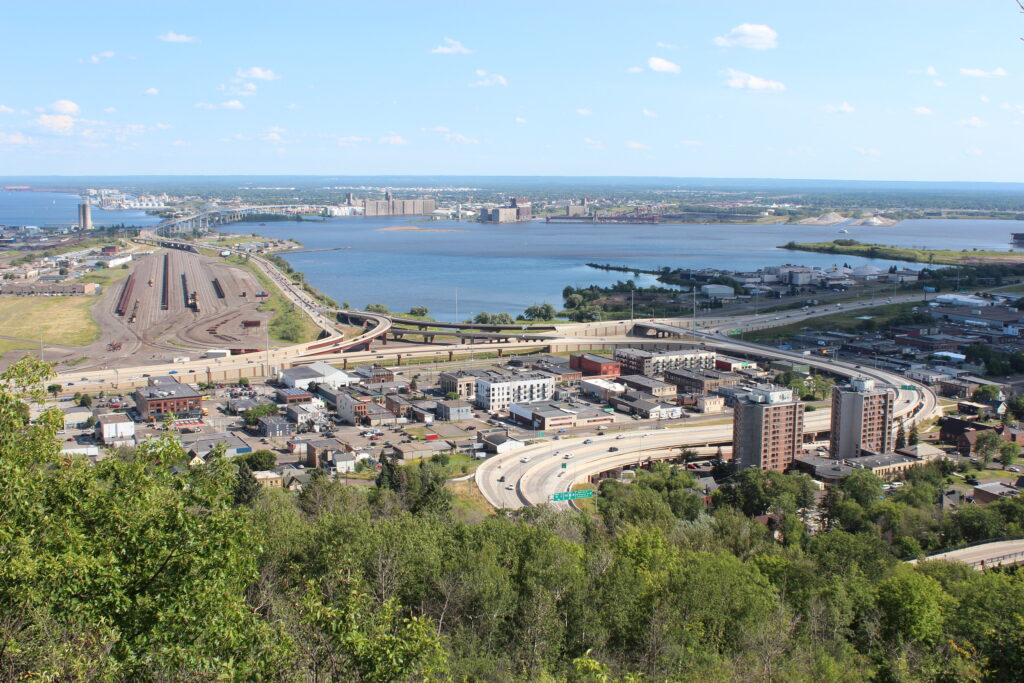
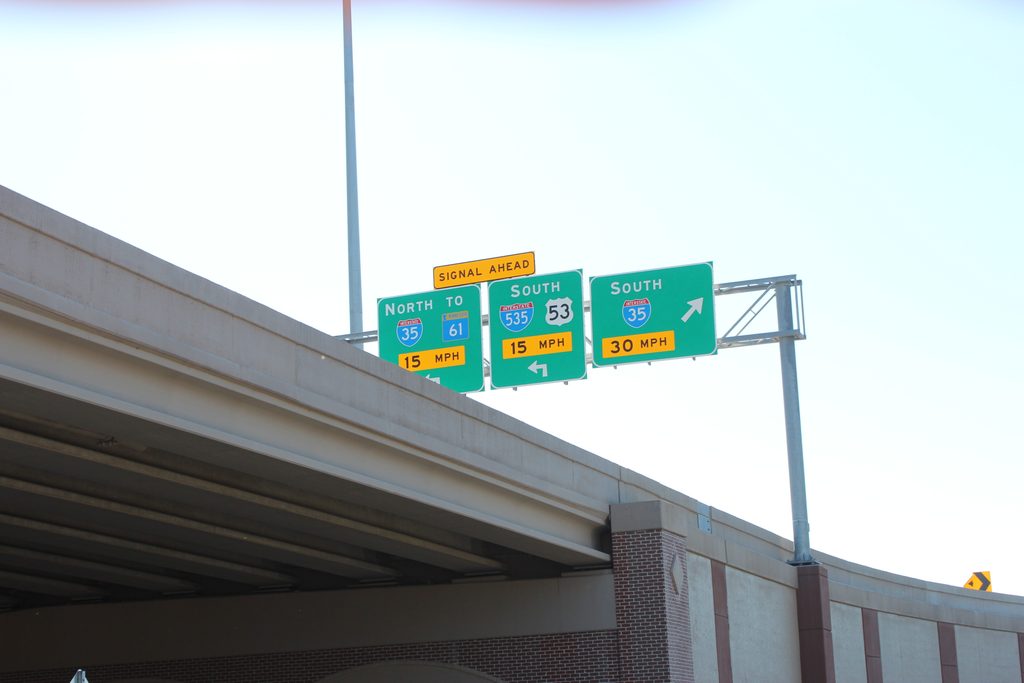
After years of planning and more years of construction, the project to untangle Duluth’s infamous “Can of Worms” is now in the rear-view mirror. The section of roadway that interweaved I-35, I-535 and Highway 53 in the Lincoln Park area is now more pleasingly known as the Twin Ports Interchange and is also much easier to drive, dispensing with the left exits and blind merges and so on that once made it a challenge to traverse.
It was a massive project, bringing together scores of local and regional contractors of all stripes under the leadership of the Minnesota Department of Transportation, and it had to overcome hurdles like a global pandemic as well as unexpected discoveries during construction that had to be addressed.
But the fact that so many Northland workers contributed to such a huge community effort meant to benefit the entire region meant that, even though the TPI was a tremendous task to undertake, it was done by the community for the community. If not a labor of love, then something akin to that.
Patrick Huston is Assistant District Engineer of Major Projects for District One with MnDOT. He’s been with them for 36 years, and he was a key figure in the TPI project. The Duluth native’s resume is filled with experiences that trained him well for it when the day came.
“It was kind of odd,” he recalled. “We recognized, if you think about all of our infrastructure, the interstate was kind of built in the same era, right? And in Duluth in particular here, I-35 and that Can of Worms interchange was coming due kind of in the same era as the Blatnik Bridge. So Duane (Hill, District Engineer with MnDOT) as our leader really recognized that, and took it to heart. He worked with our leadership to try to secure funding while we were actually going to work developing the job with alternatives and stuff.”
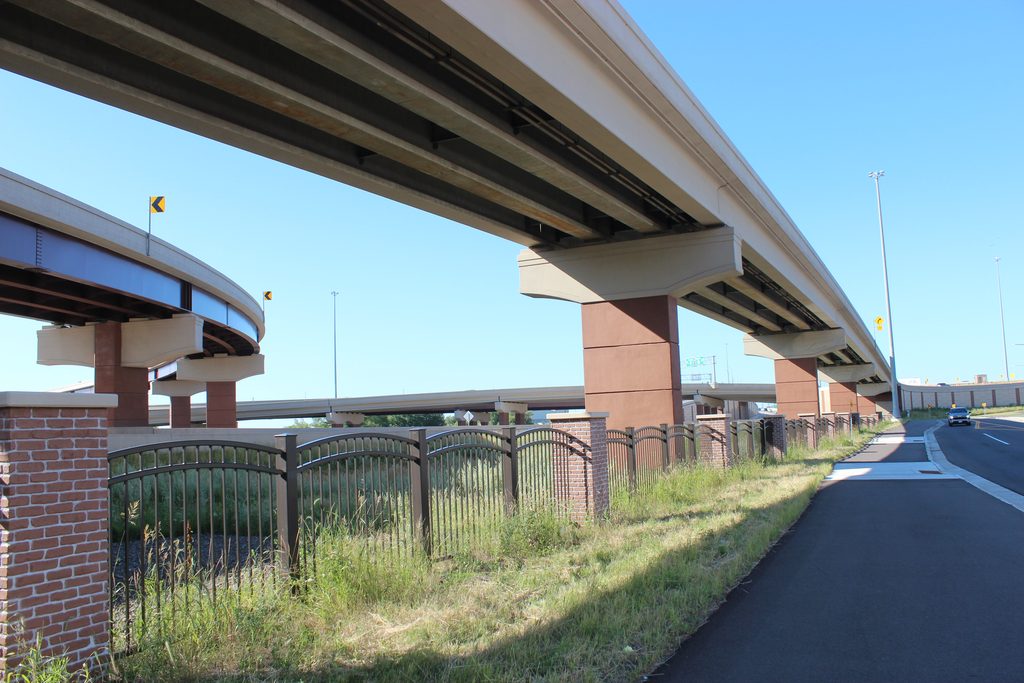
A key part of the TPI was that it needed to be wrapped up in time for the inevitable Blatnik Bridge replacement project, now in full swing. This meant that any planning for the TPI had to factor in the future work that would follow.
“If you look at Duluth,” Huston said, “it’s not like the Twin Cities metro with a lot of alternate routes. We’ve got two bridges and one freeway, right? So we recognized and we knew we had to get the Blatnik replaced by about 2030. We did a parallel path developing that project while trying to secure funding in order to get that done before the Blatnik Bridge.”
“People that don’t work in this industry,” Huston said, “they see the equipment show up and they have no idea what it’s taken to get to construction, right? I think we started in earnest with the project team – we co-located with our CMGC contractor in 2018 to work through all those issues and come up with the design in about two years. There’s a lot of environmental process. There’s a lot of work on all the financials. There’s just a million things that go on in the background, and they take time to do.”
The “CMGC” that Huston speaks of is a construction manager/general contractor partnership. These are somewhat novel and place a premium on collaborative processes. Here, the Ames-Kraemer Joint Venture took on that role.
“That was a unique thing for this project,” Huston said. “So, in Minnesota, we have three ways that we deliver construction contracts. It’s design-bid-build, which is the typical [method]. There’s design-build, where we do a preliminary design and the environmental permitting on that, and then contractors that marry up with designers compete to finish the full design and build the project, and that allows for some flexibility and ingenuity. And then there’s CMGC – that’s where contractors compete to be your CM. So they’re at the table during the project development, and we’re looking at all kinds of risks and how to solve them. For example, on the Twin Ports Interchange, everything was full of legacy contamination. How do we handle the soils? How do we handle the water? How do we work with the railroads? [A CMGC] allows you, before you even do the job, to basically figure out and agree on how you’re going to handle that.”
Fittingly, such a high-profile construction project that was going to take years of work was in fact planned in advance to be a shining example of how many different companies could come together and work successfully.
“Projects are like people,” Huston said. “They all have their different personalities.” Accordingly, then, acknowledging this before ground was even broken meant that the whole crew was ready for whatever came down the pike.
“When I look back on the Twin Ports Interchange, it’s the people,” Huston said, “and there were a lot of people. It was just an amazing team effort. This was kind of like going to the Stanley Cup for highway projects.”
One of the key reasons the TPI was so badly needed was that the condition of that area of roadway actually was beginning to impede the way business was done in the Twin Ports’ shipping industry. “We had load-restricted bridges,” Huston pointed out. “We couldn’t get the big loads out of the port, and we had contaminated soil and water.”
The question of how the traffic on such a prominent artery headed into and out of the heart of the downtown area of Duluth could be redirected was key, Huston recalled. But it all worked.
“I gotta tell you, in all my years here at MnDOT, that was the fewest complaints I think I had ever seen on a project,” he said. “One of the things – talk about great moments and the ingenuity of contractors – they threw us an idea early. It was actually in their proposal when they were competing for the job, I think, to reroute southbound I-35 on Michigan Street. It was a fantastic idea that the city of Duluth bought into.”
“On our jobs, we take a four-lane freeway, take the northbound traffic off, we put it in one lane over on the southbound and we go to work,” Huston explained. “But then, before winter flies, we’ve got to stop. We’ve got to get everything back where it belongs for the winter because you just can’t have that traffic configuration in snow and ice conditions, right? So this idea of having two lanes of traffic northbound on lower Michigan on a bypass [came up], and we built some temporary road, which allowed us to take northbound traffic over on the southbound side and completely work year-round on the new northbound. And then we put northbound traffic on the northbound and we kept southbound traffic over on lower Michigan and we worked year-round on southbound.”
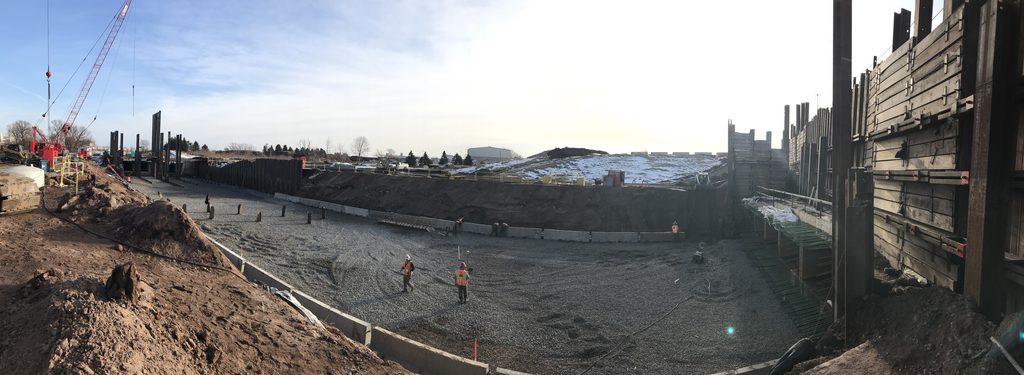
As a result of not taking things down early or waiting to set things up or being unable to work in the winter, the workers shaved a year off the project.
The fact is that the TPI project was so wide-ranging, so involved, that summarizing all of its facets or name-checking all of its partners is next to impossible. But there are aspects of the project that go a long way in explaining the kinds of skilled, ingenious minds that were on the job.
MnDOT District Engineer Duane Hill is one of those folks. Similarly to Huston, he’s seen and learned a lot in his 35 years there, and the TPI project was one of his last before his recent retirement. “My staff always say that I have this uncanny ability to step in when there are problems,” he said. “To help just at the right time.”
Given this reputation, Hill was a good one to have on the TPI job. “We kind of first saw that project as a perfect storm of a number of different small parts of the infrastructure,” he recalled.
Given how much needed updating in the area around the Can of Worms, the decision was made to kill about 15 birds with one stone. “We started having the conversation with our leadership in St. Paul about, hey, what if we tried to look at doing one large project?”
Grant money was applied for, and key in that process was noting just how much the entirety of the Northland shipping industry hinged on the roads being able to handle their needs.
“We were saying that this is the last mile to the port or the first mile from the port, and we needed to improve all the infrastructure so they can get a windmill blade or a nacelle (generator housing) on our roads,” Hill said. “We were trying to find an easier way to get them out of the port and not have to use the city streets.”
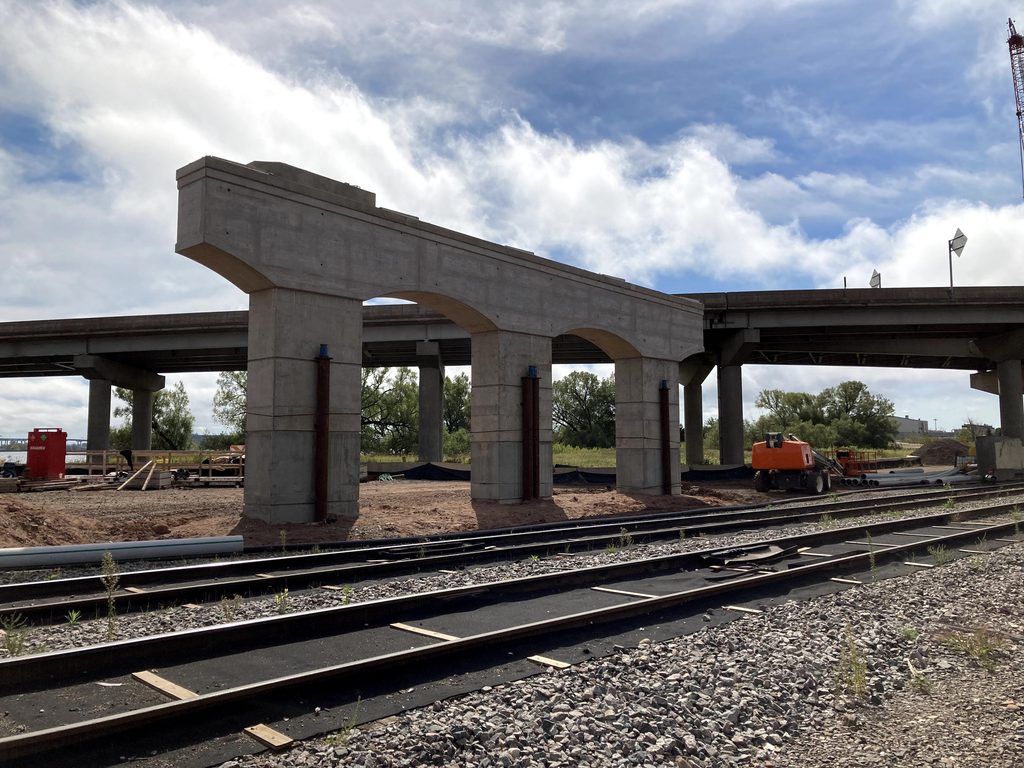
Bridges along the route were another issue. “Today, we use the term ‘non-redundant’,” Hill explained. “Back then, we called them ‘fracture critical’. There were two girder bridges, and the load-carrying capacity on them was limited because of their condition and age. They were all in our program to be replaced one at a time. If we did them one at a time, we’d take one apart, replace it, and the next year we’d do another project. We’d take another one apart and replace it. It wouldn’t have been comprehensive, it wouldn’t have had the aesthetics that we have today and we wouldn’t have been able to solve some of the other problems that we solved by doing it as one big project.”
A big moment for the TPI was when, as often can happen in the state, work had to stop for a bit due to historically significant materials being uncovered.
“On Valentine’s Day of 2023, we had our cultural-resource discovery,” Hill said. “That turned the project schedule kind of backwards and caused a lot of extra work.”
But, perhaps due to all of the diligent pre-planning that was done by all involved, Hill said “we kept the contractor engaged in the project and working the whole time while we dealt with that. The workforce remained constant during that time, and we were able to just find areas where the contractors could keep making progress while we dealt with the areas where they couldn’t.”
Jim Hall is Principal and Regional Transportation Practice Center Leader with Short Elliott Hendrickson, Inc. He functioned as a final-design roadway lead in the TPI build and partnered with many different firms to deliver that design.
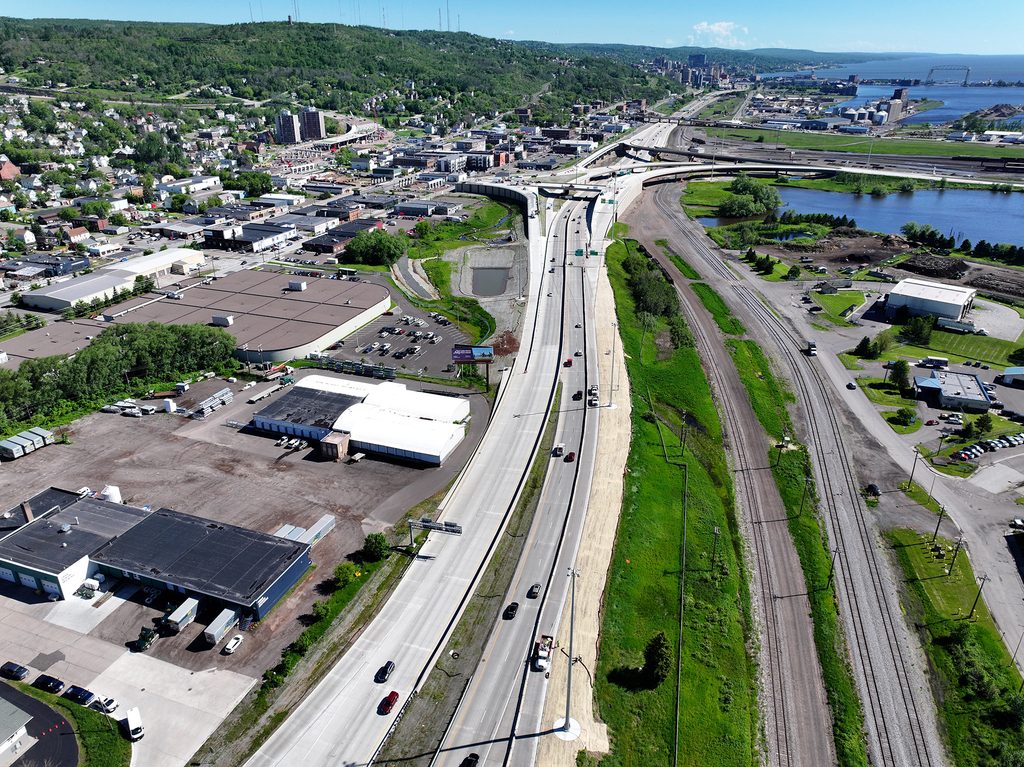
“It was probably the largest project I’ve worked on to date,” he said. “And having that large team really allowed for a variety of experts. It was a joy to be a part of it.”
Hall said he “wasn’t surprised” that the public ended up taking the disruptions to traffic that the project presented in stride. “I know that there was a huge outreach effort to coordinate with the public and also public-facing entities. A lot of public meetings, news releases, working with businesses and freight transport entities. I think everybody recognized the need for improvement.”
Jon Sitter is Engineering Director of Bridges and Structures at LHB in Duluth. He’s been with that company for 34 years, so he’s another construction vet. Thinking back on the TPI job, he said that taking apart the old bridges was challenging, as were the various surprises that were buried underground.
“We ran into lots of unique things,” he said. “We were dealing with some of that historic legacy infrastructure, like underground tunnels and storm sewers that no one knew about, and building foundations that were found.”
“It was just a fun project to be a part of because it’s in our backyard,” Sitter said. “All of the bridge group are local people here that live in the Duluth area, so to get to drive under that bridge they designed every day or every other day and see it come together during construction – that part is really cool.”
Brent Theroux is Senior Geotechnical Engineer with Barr in their Minneapolis office. They came on the TPI project after some work on it had already been done.
“We were chiefly responsible for designing the ground improvement that would support the embankments and structures on the project,” he explained.
Their role involved a high degree of difficulty and lots of coordination and planning and meetings, some virtual due to the pandemic. “It was such a novel situation,” Theroux said. “Everybody else was like ‘What do we do now?’ But, as a practical matter, the project just kept going.”
Theroux’s memories of the TPI are clear, for him, as is his estimation of how largely it looms in his mind. “It’s a cornerstone project in my career, so I look back on it very fondly,” he said. “Any design, especially one like this, is going to have its hurdles and obstacles to get over, but we did it. We didn’t have any loose ends or major unknowns at the end of it. It was a very nice project.”
All involved seem to be quite satisfied with how the Twin Ports Interchange unfurled, which certainly bodes well for the upcoming Blatnik Bridge replacement, as many of the same players are set to have roles in that next multi-year project.
It’s a time of renewal in the Twin Ports’ roadways, but the people who are working on them are in many cases the same ones that drive them on a regular basis. The TPI project was big, but the community rallied and showed how well things can be done with a little old-fashioned teamwork.
Tony Bennett is a Duluth-based freelance writer.